


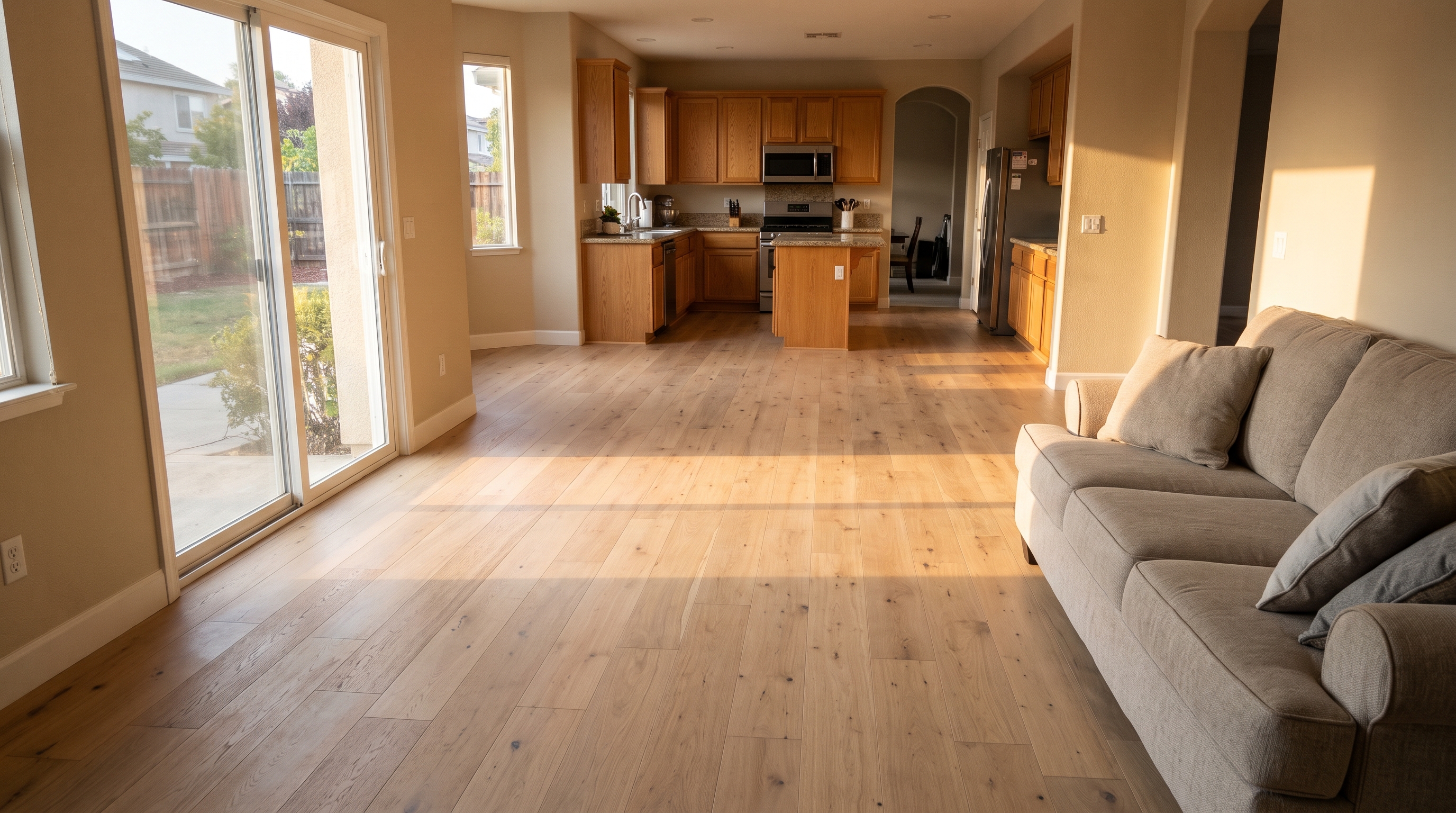
If you already have hardwood under your feet, refinishing it is the best flooring investment you can make before a sale. Real estate agents expect it to return more than it costs, and they expect new hardwood to do the same. Nothing else on a floor comes close.
Most Roseville homes are not in the price range where buyers insist on real wood, though. For a starter or mid-priced house, a quality luxury vinyl plank through the main living areas is what we usually recommend, and fresh carpet in the bedrooms protects your price rather than raising it.
What matters even more than the material is the condition of the floor you have now. A worn or damaged floor costs you at the sale, because buyers price a visible project at more than the fix would have cost. A sound floor in a current color usually needs nothing more than a good cleaning.
| Floor type | What it does for the sale | Where it helps most | Skip it when |
|---|---|---|---|
| Refinished hardwood | Returns more than it costs in agents' estimates | Any room with sound hardwood under a tired finish | The finish is intact and the color is current |
| New hardwood, solid or engineered | Also returns more than it costs, and it is the floor most buyers want | Living and dining rooms, the entry, halls and an open kitchen | Sound hardwood is already down and can be refinished |
| Luxury vinyl plank | Moves a dated main floor into the updated column | The main living areas of starter and mid-priced homes; kitchens, laundry rooms and baths in any home | The plank you have is current, flat and undamaged |
| Laminate | Holds a price when it is current and dry | Bedrooms, halls and living areas away from standing water | The boards are flat and the seams are tight |
| Porcelain tile | Meets what buyers expect in wet rooms | Bathrooms, laundry rooms, entries and closed kitchens | The tile is sound and the grout is clean |
| Carpet | Protects a price and gives bedrooms the soft floor buyers still want there | Bedrooms | The carpet is clean, with no worn paths, stains or odor |
What Flooring ROI Really Measures When You Sell
Flooring ROI gets quoted online as if it were one number. It is really three, and each one answers a different question: what agents expect a project to recover, what homes that already have a floor sell for, and how many buyers want that floor in the first place.
Underneath all three sits a fourth thing that never gets a percentage, which is how the appraiser on your buyer's loan rates your floors. That is where most of a floor's resale value actually lives, so it gets its own section below.
What Agents Expect a Floor to Recover
The National Association of Realtors publishes a Remodeling Impact Report with the National Association of the Remodeling Industry. Remodelers estimate what each project costs, and agents estimate what it adds to the sale price.
In the 2022 edition, refinishing hardwood floors recovered 147 percent of its cost and new wood flooring recovered 118 percent. Those were the two best results of any interior project, and 22 percent of agents said they recommend refinishing hardwood to sellers before listing.
These are national estimates from the people who price listings for a living. Your house will not match the percentages exactly, but the order of the projects carries over to a Roseville sale.
What Homes With the Floor Actually Sell For
Zillow's economists have studied this several times. They analyzed the listing descriptions of millions of sold homes and compared each sale price with what the home's size, age and location predicted. Homes whose listings mentioned hardwood floors sold for about 2 percent more than expected in a 2016 study and about 10 percent more in a 2018 study.
Carpet works differently. In the previous 2016 and 2018 studies, listings that mentioned new carpet sold for about what was expected. That is not a knock on carpet, however. It is a more of a description of carpet's job at a sale, which is to remove a reason to offer less rather than to add a premium.
How Many Buyers Want It
The National Association of Home Builders surveys recent and prospective buyers every few years for a report called What Home Buyers Really Want, which builders use to decide what goes into new houses. In the 2024 edition, 81 percent of buyers rated hardwood flooring on the main level essential or desirable, which put it among the most-wanted features in a home.
That matters in two ways for a resale listing here. It tells you what buyers walk in hoping to see, and it describes the new homes going up in west Roseville, Lincoln and Rocklin, which are the houses yours will be compared against.
Demand like that never appears as a percentage on your closing statement. It shows up as more showings booked from the photos, stronger offers and fewer buyers asking for a flooring credit after the inspection.
How an Appraiser Rates Your Floors
Unless your buyer pays cash, the lender will order an appraisal, and the appraiser does not add a line item for new floors. Floors feed into the home's condition rating and its quality rating, and the comparable sales do the rest.
Fannie Mae and Freddie Mac buy most of the conventional mortgages written in the United States, and lenders appraise to their rules. Their redesigned appraisal format, which is required for appraisal reports from November 2, 2026, rates condition on a scale from C1, for a brand-new home, to C6, for a home that needs substantial repair.
Floors are named at three points on that scale. A C3 home is well maintained and may have updates such as new or newer floor coverings.
A C4 home shows minor deferred maintenance, and worn floor finishes or carpet that shows its age are the examples given. A C5 home has severely worn, damaged or missing floor coverings.
So a tired floor can slide an otherwise well-kept house from C3 to C4, and a new one can lift it back. The quality rating counts floor material too, alongside the kitchen, the bathrooms, the ceilings and the trim. The appraiser and the buyer standing in your living room are judging the same thing: whether the house looks cared for and current, or looks like a project.
What a Typical Roseville House Has Underfoot
The median home in Roseville was built in 1998, according to the U.S. Census Bureau's American Community Survey estimates for 2020 through 2024. Rocklin's median is also 1998, Folsom's is 1997 and Lincoln's is 2005. The older communities run earlier: 1987 in Granite Bay, 1977 in Citrus Heights and 1976 in Orangevale.
A house from the late 1990s is nearing thirty, which is past the life of its first carpet and often its second. It probably came with carpet in the bedrooms, the hall and the living room, and ceramic tile or sheet vinyl in the kitchen, the baths and the laundry room. Some might have had strip oak in the entry or dining room, finished in the orange tone that was popular back then.
Most of these homes sit on a concrete slab, which shapes the wood decision. An engineered plank can be glued or floated over concrete, as our guide to engineered versus solid hardwood on a slab explains, while solid planks need a wood subfloor built first. Rigid-core vinyl and laminate float over a slab as well.
The climate does the rest. Long summers pour afternoon sun through west-facing sliders and fade the floor in its path, so the room with the best light is often the room that most needs a new floor and is the hardest to photograph. Grit from the yard and the trails wears the finish at the entry and along the path to the kitchen.
Homes from the 1960s and 1970s, which are common in Citrus Heights and Orangevale, may have vinyl tile or sheet vinyl that contains asbestos. The U.S. Environmental Protection Agency advises homeowners to leave undamaged asbestos flooring in place and, when it has to be replaced, to install the new floor over it where possible rather than sanding or scraping it. If you pull up old carpet and find vinyl underneath, have a sample tested before anyone disturbs it.
Your neighbors' floors matter too. A buyer compares your house with the others on the street, and the appraiser draws comparable sales from the same tract. Where half the houses have already swapped carpet for a plank floor, the other half are the ones a buyer walks through and calls a project.
Which Flooring Types Add the Most Resale Value, Ranked
For a floor that has to be done before a sale, the order runs like this. Refinished hardwood comes first, because the material is already paid for, and new hardwood comes second as the floor most buyers ask for.
A quality luxury vinyl plank comes third, and in starter and mid-priced homes it moves ahead of new hardwood for the main living areas, for reasons the LVP section explains. Laminate comes fourth.
Tile and carpet are chosen by room rather than ranked: porcelain where water lives, carpet where buyers still want a soft floor.
One rule sits above the ranking. If the floor you have is sound and its color is current, leave it alone and spend the budget on the floors that need help. The floor you do not have to buy is the best return of all.
Refinished Hardwood: The Best Return in the House
Refinishing wins because you are buying labor and finish, not wood. The result looks like a new hardwood floor to a buyer and counts as an updated one to an appraiser.
The floor has to be able to take it. Solid hardwood three-quarters of an inch thick can usually be sanded three to five times over its life, so a 1990s oak floor almost always has a sanding left in it. Engineered hardwood can be sanded only if its top layer of real wood is thick enough, and the exposed edge of a board at a floor register or a doorway shows which kind you have.
Not every tired floor needs the full treatment. A floor that is dull but not worn through can be screened and recoated, which scuffs the old finish and lays a fresh coat over it. Worn paths, deep scratches and water marks call for a full sand, which is also the only way to change the color.
A simple test tells you which you need. Drip a little water on a worn spot. If it beads, the finish is still sealing the wood, and if it soaks in and darkens the wood, the finish has worn through.
Tell whoever refinishes the floor about any wax or polish it has had, because both can keep a new coat from bonding.
In a 1990s house, the color change is where a refinish earns the most. Much of the orange in oak floors from that era comes from oil-based finishes that have yellowed with age, and sanding takes it off along with the old finish. Red oak keeps a natural pinkish warmth under a clear coat, so if you want a cooler, more neutral look, test a few stain samples on the boards before deciding.
Some older homes in Citrus Heights, Orangevale and the original neighborhoods of Roseville have oak hiding under the carpet. Pull back a corner in a closet. If the boards are there and sound, refinishing them is the best-returning flooring project you can do before a sale.
Our own crews do the sanding and finishing, so a refinish in one room and a new floor in the next can be planned as one job.
New Hardwood, Solid or Engineered
New wood flooring returned more than its cost in agents' estimates, second only to a refinish, and it is the floor four buyers in five want on the main level.
Buyers and appraisers see wood, not construction. Solid and engineered hardwood look the same once they are down, the listing says "hardwood floors" either way, and the comparable sales do not tell them apart. The differences are in how each is installed and how many times it can be sanded.
For resale, choose a natural white oak or a similar pale, straight-grained species, planks five inches wide or wider, and a matte finish. With engineered hardwood, make sure the wear layer, meaning the top layer of real wood, is thick enough to sand at least once. Buyers notice tone, width and finish far more than whether the board is solid or engineered.
Put it where buyers look first: the living room, the dining room, the entry, the halls and, in an open plan, the kitchen. Wood in the bedrooms is pleasant but returns less, because carpet is still welcome there.
Our hardwood catalog carries solid and engineered planks from makers including Mirage, Hallmark Floors, Fabrica and IndusParquet.
Luxury Vinyl Plank: The Best Buy for Most Roseville Price Ranges
In a starter or mid-priced home, a quality rigid-core luxury vinyl plank across the main living areas is usually the smartest move. It replaces worn carpet or dated tile with a floor that photographs well, counts as updated, and stands up to water, pets and children in a way no wood floor can.
In homes at the top of the local market, buyers expect real wood in the living areas and notice when it is missing. Both things are true, which is why agents disagree about LVP.
Agents who sell starter and mid-priced homes see buyers who want a clean, modern, low-maintenance house. Agents who sell luxury homes see buyers who expect wood underfoot. Each is describing their own buyers.
What separates a plank buyers admire from one they overlook is what they see and feel. Look for a matte finish, an embossed texture that follows the printed grain, planks at least seven inches wide and four feet long, and enough different plank faces that repeats are hard to spot.
On a busy main floor, choose a wear layer of at least 20 mil. The wear layer is the clear top layer that protects the printed design, and a mil is a thousandth of an inch.
LVP is also the right answer where wood struggles: kitchens, laundry rooms and bathrooms, a slab that tests damp, a house with dogs, and a rental going to its first owner-occupant. Our luxury vinyl catalog includes rigid-core lines such as Mannington ADURA APEX and COREtec.
Laminate: A Wood Look That Holds Its Value
A current wood-look laminate in good condition neither helps nor hurts a mid-priced sale. Buyers see a wood floor and move on, which is exactly what you want from a floor before a sale.
Laminate's hard top layer resists scratches from pets and grit, which is why it belongs in bedrooms, halls and living areas. Its core is wood fiber, so in the rooms where water sits, such as a full bath or the laundry room, a waterproof plank is the safer choice.
What hurts at a sale is damage, not the material. A raised or swollen seam tells a buyer the floor has been wet, and that is what they remember. Fix the source and replace the damaged boards before you list.
For busy rooms, choose a plank rated AC4 or higher, which is the wear class for heavy residential traffic, with a matte, embossed surface and a width in step with current wood floors. Mohawk and Mannington laminate lines are in our laminate catalog.
Tile and Stone: Expected Where Water Lives
Tile holds value where buyers expect it: bathrooms, laundry rooms, entries and closed kitchens. In this market, it does not earn the premium across living areas that wood does.
For a floor, porcelain is the stronger choice over ceramic, because it is denser and absorbs less water. A 12 by 24 inch or larger porcelain in a soft neutral is the current look for a bath.
A wood-look porcelain plank gives a closed kitchen the tone of the wood in the next room without the water worry. Natural stone signals the luxury tier and suits homes priced for it.
Replacing tile is the most disruptive flooring job in a house, so a sound tile floor is often the right one to keep before a sale even when the color is not what you would choose today. Clean it, refresh or recolor the grout, and recaulk the joint at the tub and the walls. Porcelain from Daltile, Marazzi, MSI, Emser Tile and American Olean is in our tile catalog, and natural stone has a catalog of its own.
Carpet: The Bedroom Floor That Protects Your Price
Carpet protects a price rather than raising one. Worn, stained or pet-scented carpet loses offers, and fresh neutral carpet in the bedrooms is the quickest way to make those rooms photograph clean.
Bedrooms are still carpet's home turf. Buyers expect a soft, quiet, warm floor there, and carpet delivers that better than anything else. In the main living areas, most buyers want a hard floor, so that is where carpet costs you.
Your household makes the bedroom call. Dogs and allergies argue for a hard floor you can wipe. Children, a bedroom that gets cold in winter, and the feel of carpet underfoot first thing in the morning argue for keeping it.
If you carpet a bedroom for a sale, choose a neutral mid-tone and a dense pile over a good pad. A textured cut pile hides footprints and vacuum marks, so the rooms look freshly vacuumed at every showing. With pets, start with the fiber: nylon springs back under traffic, and solution-dyed fibers, which have the color built into each strand, hold up to repeated cleaning.
A carpet lasts about 5 to 15 years, so carpet bought a few years before a sale will still look fresh at the showing. Masland, Fabrica, Anderson Tuftex and Engineered Floors are among the makers in our carpet catalog.
Which Rooms Matter Most for Flooring When You Sell?
The main living areas and the kitchen matter most, because buyers make up their minds there and the listing photos are taken there. The entry and the bedrooms come next. Bathrooms and laundry rooms are judged on whether they are clean and dry, and stairs show wear before any room does.
| Room | Floor that helps the sale | What costs you |
|---|---|---|
| Living room, dining area and open kitchen | One wood or LVP floor through all three | Worn carpet, or three different floors in one view |
| Entry and halls | The same floor as the living areas, or a porcelain in a matching tone | A small patch of different tile inside the front door |
| Bedrooms | Fresh neutral carpet, or the main-floor plank in a primary bedroom that opens off the living area | Stained, worn or pet-marked carpet |
| Bathrooms and laundry room | Porcelain tile or a waterproof plank | A soft spot, a seamed sheet floor or a swollen board |
| Stairs | Treads that match the floors they connect | Worn or loose carpet on the nosings |
| Bonus room or converted garage | A finished floor such as LVP, laminate or carpet | Bare or painted concrete |
In most Roseville floor plans, the living room, dining area and kitchen open into each other, and a buyer sees all three from the front door. One floor should run through all of them. Change floors only where a wall or a doorway makes a natural break, at a bathroom, a laundry room or a closed kitchen.
If the kitchen keeps its tile to save the budget, the tile has to be clean, the grout has to be fresh, and the new living-area floor should sit comfortably beside it in tone. Make the change in a straight line where the kitchen begins, not partway across a room.
The entry sets the first impression and takes the most grit, so it should carry the same floor as the living areas or a porcelain that matches them in tone. A small square of different tile inside the front door, with a metal strip to the carpet beyond, is a detail buyers associate with a house nobody has updated.
Bedrooms are where a tight budget goes furthest. Fresh neutral carpet changes how every bedroom photographs. If the main floor is getting a new plank, carrying it into a primary bedroom that opens off the living area is worth doing, and the other bedrooms can stay carpeted.
Bathrooms and laundry rooms pass or fail on dryness. Sound tile with fresh grout and new caulk passes. A soft spot in front of the toilet, a seam in sheet vinyl or a swollen board by the washer does not, and the fix in those rooms is porcelain or a waterproof plank.
Stairs are the first thing a buyer touches on the way up, with a hand on the rail and a foot on every tread. Carpet wears at the nosings first, and a wood or LVP stair has to be fitted one tread at a time, so stairs deserve their own decision. Whatever you choose, match them to the floors they connect.
A bonus room or converted garage is where a buyer forgives a modest floor, as long as the room looks finished. Bare or painted concrete in a room the listing calls living space is what a buyer counts as unfinished.
Should You Replace Your Floors Before Selling?
Replace a floor before you list when it is the first thing a buyer will see wrong. Leave a sound, clean floor alone, even one whose color you are tired of, and price the house for it.
Worn carpet, a swollen laminate seam, cracked tile and a patchwork of floors on one level each cost more in the offer than they cost to fix. A sound beige-tile kitchen or a newer engineered floor in good shape costs you little, and replacing it returns little.
Go room by room and ask one question: would a buyer mention this floor to their agent? Clean carpet and hardwood with a few light scratches, no. A pet smell, a gray path to the sofa, a lifted plank or three different floors in one view, yes, and that is the floor to deal with.
It helps to picture who is buying. In the National Association of Realtors' 2025 Profile of Home Buyers and Sellers, which covers purchases from July 2024 through June 2025, the median buyer nationwide was 59 years old. The median repeat buyer, meaning someone who had owned a home before, was 62.
Those are national figures, but they describe the buyer who moves within this area too: someone who has owned before, has often just sold a house to get here, and knows what a renovation costs. Buyers like that pay for move-in ready and discount for projects, and a floor is the most visible project in a house.
Clean, Re-Stretch, Repair, Refinish or Replace: The Order to Try
Start with the simplest fix that removes the flaw, and move to the next only if the flaw is still there. Many floors that look like they need replacing are a cleaning or a repair away from giving a buyer nothing to notice.
- Clean. Professional hot-water extraction brings back carpet that is dirty rather than worn. If the stains return within a week, or the smell comes back once the carpet dries, the pad is soaked and the carpet has to go.
- Re-stretch. Ripples and loose edges in carpet that is otherwise sound are fixed by stretching it back tight, which is a short job.
- Repair. One cracked tile, a gouged plank, a lifted laminate board or a worn threshold is a repair, and a spare carton from the original installation makes the repair hard to spot.
- Refinish. A dull wood finish needs a screen and recoat. A finish that is worn through or the wrong color needs a full sand.
- Replace. When none of the above gets the floor to a state where a buyer says nothing, replace it, starting with the rooms buyers see first and using the floor the ranking puts there.
Each step has a test you can run yourself. Press a damp white cloth on the carpet after cleaning and see what comes up.
Look across a laminate floor at a low angle for raised seams, which mean swelling rather than dirt. Tap a tile with a coin and listen for a hollow sound, which means it is loose and not just cracked.
We re-stretch carpet, repair floors and refinish hardwood ourselves, so most of the steps on that list are jobs we can take on before anyone decides a floor has to go.
A Flooring Credit or New Floors?
New floors are the better choice when the house will be photographed and shown to buyers who plan to live in it. Worn floors in the listing photos keep some buyers from booking a showing at all, and a credit does nothing for the photos.
A credit also does not change what a buyer imagined. The buyer who sees worn carpet in person pictures a bigger project than the one you priced, and the buyer who wanted a finished house simply moves on to the next listing.
A credit is still the right call in two cases. If the likely buyers are investors who will put in their own floors anyway, there is no point paying for floors they will tear out. And if you are selling as-is on a short timeline, a written estimate for the floor gives the buyer a real number to work with instead of an imagined one.
How Far Ahead of the Listing Photos to Start
Floors go in before the painter's last touch-up, the stager and the photographer, and a refinish needs time to cure before furniture and rugs go back. Start the conversation about two months before the date you want to list, so the order, the installation and the curing all land before the camera does.
- Measure the rooms and choose the floor.
- Order it, and let wood flooring sit in the house to acclimate for as long as its maker recommends.
- Move the furniture out and take up the old floor.
- Install the new floor, or sand and finish the existing one.
- Let the finish cure before the furniture goes back, and wait longer still before rugs go down.
- Return the furniture, touch up the paint and stage the rooms.
- Shoot the photos.
Plan the rooms that will be photographed first and the garage or bonus room last. When we install, our crews can move the furniture out and take the old carpet away, which matters in a house you are still living in.
Floor Problems That Shrink Offers, and the Fix for Each
The problems that shrink an offer are the ones a buyer notices in the first minute. Each has a tell, a fix, and a point where the fix becomes a replacement.
| Problem | How you can tell | The fix |
|---|---|---|
| Pet odor in carpet | The smell returns after the carpet is cleaned and dries | New carpet and pad in that room, with the subfloor sealed before the new pad goes down |
| Swollen laminate seam | A raised ridge you can feel through a sock | Stop the leak, then replace the damaged boards, or the whole room if the swelling has spread |
| Cracked or hollow tile | A coin tap sounds hollow, or a crack shows | Reset one or two loose tiles; a floor that is hollow in several places needs relaying |
| Worn path in a wood finish | Gray or bare wood from the slider to the kitchen | A full sand and refinish, because a recoat will not hide bare wood |
| Patchwork of floors on one level | Three floors visible from one spot | Carry the best floor, usually the plank, through the connected rooms |
| Installation that shows | Gaps at the walls, rocking planks, end joints lined up in a row, a transition strip that sits proud | Most are repairs; a floor that moves underfoot has to come up and be laid again |
Pet odor is the costliest problem on the list, because the smell meets the buyer at the front door and no cleaning reaches a soaked pad. Cracked tile is a repair if the floor under it is sound, but cracked tile over a cracked slab will crack again unless the slab is dealt with first. An installation that shows its gaps makes a buyer wonder what else in the house was done the same way.
Which Colors, Widths and Finishes Sell Now?
The look with the broadest appeal right now is a natural mid-tone wood color, planks five inches wide or wider, and a matte finish, run as one floor through the connected main rooms. It suits the furniture most buyers already own, hides everyday dust, and photographs well.
White oak in a natural or lightly warmed finish is the hardwood version of that look, and many LVP and laminate designs are modeled on it. If you are replacing an orange-toned floor from the 1990s, that natural tone is where the change will show most. Wide planks, natural tones and matte finishes are also the choices that hold up as trends move on, which matters if the sale is a few years out.
Let the room's light move the choice a shade or two. A north-facing living room takes a slightly warmer plank so it does not go cold. A room with a west-facing slider takes a mid-tone, because a mid-tone hides both the fading the sun will cause and the dust it will show.
Judge every sample in the room it is going into, at the time of day the photographer will shoot. A plank that looks right under store lighting can turn pinker or grayer in afternoon sun through a slider. Our shop-at-home service lets you make that choice without leaving the house.
If You Are Staying: Floors That Hold Their Value Over Ten Years
If a sale is years away, buy the floor that can be renewed instead of replaced. That means a refinishable wood, solid or engineered with a thick wear layer, or a rigid-core luxury vinyl plank with a 20 mil or thicker wear layer where water and pets rule. The same national survey of buyers and sellers cited earlier found that the typical seller had owned the home for 11 years, so the floor you buy for yourself will almost certainly meet a buyer one day.
What ages a floor here is grit from the trails and the yard, afternoon sun through the glass, dogs, and water at the dishwasher and the slider. A matte, textured surface hides the wear that dogs and grit leave, and a refinishable wood lets you reset the floor before you sell instead of buying a new one. The daily habits in our guide to protecting hardwood from scratches stretch the years between sandings.
Keep two spare cartons from the same production lot, and store them indoors rather than in a garage that bakes all summer. A plank swapped in from the same lot is hard to spot. One from a later lot is a different shade, and a buyer sees the patch.
Carpet in a busy room will probably be replaced before a sale a decade out, so buy it for the comfort you want now and plan its replacement into the selling budget. In a bedroom, a dense, well-made carpet can go the distance.
Choose the color for the house and the light, not for the moment. A natural mid-tone matte oak look was current ten years ago and is current now.
How Granite Bay Flooring and Design Helps Roseville Sellers and Buyers
We are a family-owned flooring store in Roseville, and we have been in business for more than 45 years. Our own crews handle installation and hardwood refinishing, so a refinish in one room and a new floor in the next can be planned as one project on one schedule.
Design consultation and our shop-at-home service settle color and width before anything is ordered. We also repair floors, re-stretch carpet, move furniture and dispose of old carpet, and financing is available for a floor that has to go in before the house sells.
It starts with a free in-home measurement. We measure the rooms, look at the floors you have, tell you which can be refinished and which should be replaced, and lay out the options. We work from Roseville and serve Granite Bay, Rocklin, Lincoln, Loomis, Folsom, El Dorado Hills, Citrus Heights, Antelope and Orangevale.
Questions People Ask About Flooring and Home Value
Does Luxury Vinyl Plank Hurt Resale Value?
Not in starter and mid-priced homes, where a quality LVP counts as updated and suits how most buyers live. In the top tier of the local market, buyers expect real wood in the main living areas, so there LVP belongs in the kitchen, laundry and baths rather than the living room.
Is Tile or Wood Better in a Kitchen for Resale?
In a kitchen that opens to the living room, use the same floor as the living room, whether that is hardwood or LVP, because buyers want one floor through the space. In a closed kitchen, porcelain is a durable choice that handles water well, and a wood-look porcelain plank keeps the tone of the wood next door.
Should the Whole House Have the Same Flooring?
No. Rooms that open into each other should share one floor, but bedrooms can be carpeted and bathrooms can be tiled. Buyers react to a change of floor in the middle of an open space, not to a change at a doorway.
Are Dark Floors Bad for Resale?
Not bad, but riskier than a mid-tone. A dark floor shows dust, pet hair and every scratch, photographs smaller, and narrows the buyer pool to people who like the look.
In a large, bright room with white walls it can look expensive. In a small or north-facing room it feels heavy.
Does Hardwood Under the Carpet Add Value If You Leave It Covered?
Very little. A buyer cannot pay for a floor they cannot see, and a listing line that says "hardwood under carpet" asks them to price the carpet removal and the refinish into their offer, usually on the high side. If the boards are sound, pull the carpet and refinish them before you list.
Is It Worth Replacing Carpet in a Rental Before Selling It?
Yes, if the buyer will live in the house and the carpet is stained or smells, because that buyer prices the house on how it looks at the showing. If the buyer will be another landlord, clean and sound is enough, and new carpet is money the next owner may tear out. A quality LVP in the main rooms satisfies both buyers.
Should You Replace Flooring in a House You Are Selling As-Is?
Usually not. An as-is sale tells buyers to expect projects and draws the investors who will put in their own floors. The exceptions are a pet-odor carpet, which keeps buyers from walking through the house at all, and a hazard such as a loose board on the stairs, which the inspection will flag anyway.
Get Your Floors Looked At Before You List
Bring us the date you plan to list and the rooms that worry you. We will measure, tell you which floors need nothing, which need a refinish and which should be replaced, and help you choose before the photographer arrives. Book a free in-home measurement to get started.


