


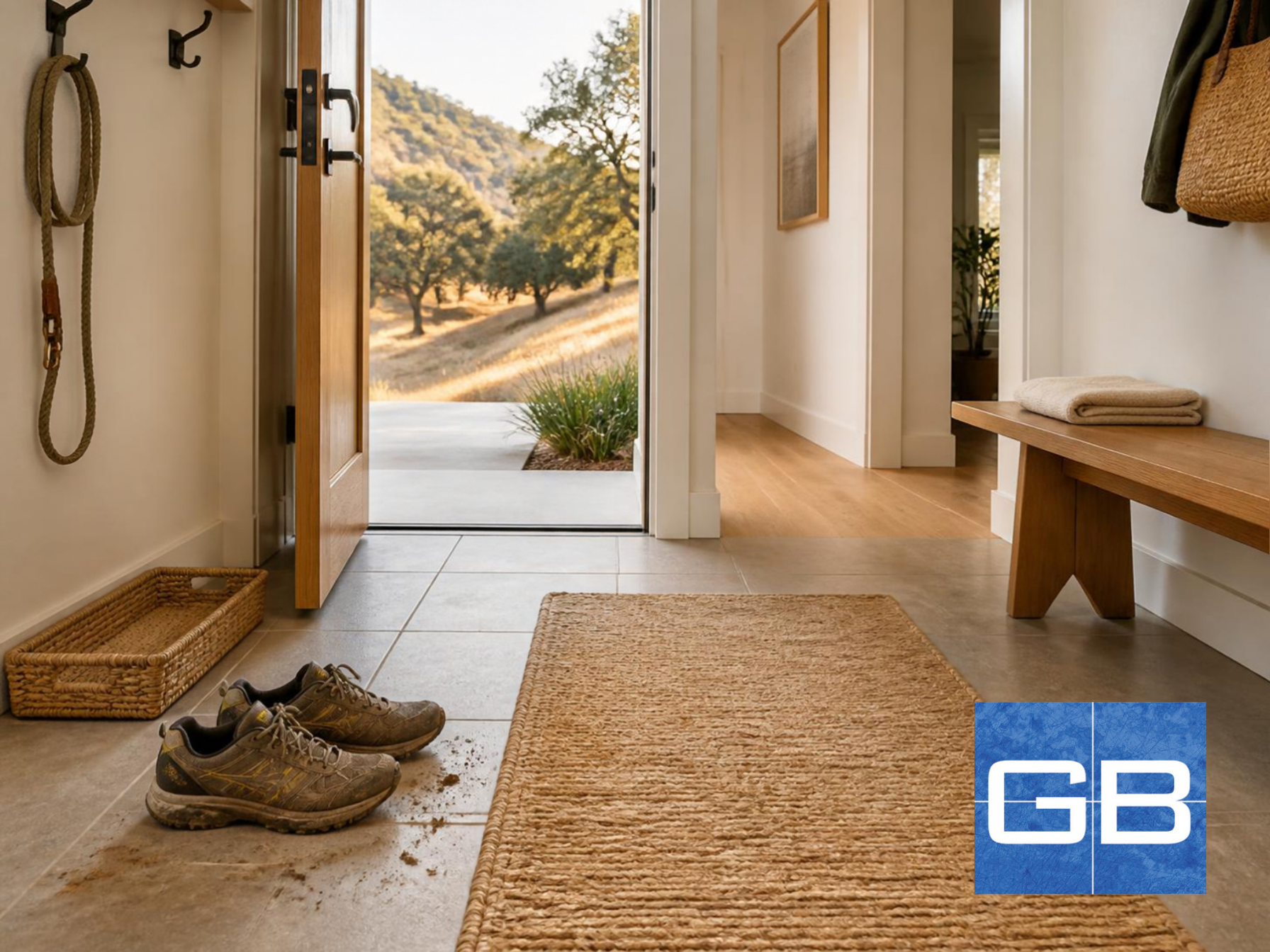
For a household that lives on the trails, the most scratch-resistant floors are matte porcelain tile and laminate with a high wear rating. Luxury vinyl plank and hardwood can hold up well too, as long as you choose the right surface and finish.
Around Granite Bay and Roseville, though, the floor is only half the answer. The ground here is coarse, gritty sand weathered from granite, and that grit, carried in on shoes, paws and bike tires, is what scratches floors.
So the best plan has three parts. Stop the grit at the door, choose a surface hard enough to survive what gets through, and pick a finish that hides the rest.
The short answer: how each floor handles grit
Use this table to narrow the field. Each floor gets its own section below.
| Floor | What resists scratches | What to check | What hides wear | Best spots |
|---|---|---|---|---|
| Matte porcelain tile | A glazed surface harder than quartz sand | A matte finish, not polished | Texture and color variation | Garage entries, mudrooms, kitchens |
| Laminate | A hard, clear wear layer over the printed design | The wear rating (AC rating or NALFA certification) | Low gloss and embossed texture | Living areas, halls, bedrooms |
| Luxury vinyl plank (LVP) | A clear vinyl wear layer | Wear-layer thickness, plus how the product actually tested | Matte, textured finishes | Busy family rooms, pet homes, laundry rooms |
| Hardwood | The finish takes scratches, and the wood's hardness resists dents | A factory finish and a harder species | Wire-brushed or hand-scraped texture, low sheen | Living rooms and bedrooms, with rugs at entries |
Why trail dirt here is so hard on floors
Scratches often start with grit. A grain of sand caught under a shoe, a chair leg or a dog's paw gets dragged across the surface, and the harder the grain, the deeper the mark.
Around here, that grit is quartz-rich sand.
The ground is decomposed granite
Soil in the foothills east of Roseville often weathers out of granite-type bedrock. The USDA's reference site for the Andregg soil series, found across the lower Sierra foothills, sits 3 1/2 miles east of Roseville.
According to the USDA, Andregg soil forms from granodiorite, a close relative of granite. It's a coarse sandy loam, more than 40% medium sand or coarser.
Granodiorite is made mostly of quartz and feldspar. On the Mohs scratch-hardness scale, which runs from 1 (talc) to 10 (diamond), quartz rates a 7 and feldspar about a 6.
That's why local dirt acts like fine sandpaper. A grain of quartz can scratch anything softer than itself, and many floor surfaces are.
Dust in summer, mud in winter
The seasons change the grit's form, not its effect. At Sacramento Executive Airport, normal rainfall for July is zero, and June through September add up to less than half an inch, according to NOAA's 1991 to 2020 climate normals.
Trails turn to fine dust in those months, and that dust drifts in on everything. Then about 18 inches of rain arrive each year, more than 80% of it from November through March.
Winter brings mud, which dries on boots and paws and turns back into grit indoors. Either way, your floors see abrasive sand year-round.
Miles of trail, and a lot of feet, paws and hooves
Folsom Lake State Recreation Area has close to 100 miles of trails shared by hikers, cyclists, runners and horseback riders, and about 2 million people visit each year. Granite Bay is one of its main entrances.
California State Parks allows dogs on the park's trails and in the water, though not at the designated swim areas. That means wet, sandy dogs are a normal part of a Folsom Lake day, and a summer afternoon at Granite Bay's main beach sends sandy feet home too.
Up the road near Auburn, Placer County's Hidden Falls Regional Park covers 1,200 acres with more than 30 miles of dirt trails for hiking, biking and horses. It's popular enough that weekend parking takes a reservation, and a county expansion approved in 2024 will eventually bring it to about 60 miles of trails across more than 4,000 acres.
Every one of those trips ends back home. Trail shoes, bike tires, riding boots and dog paws all carry decomposed granite through the door.
Water-wise yards bring the gravel closer
The grit isn't only on the trails. Roseville's Cash for Grass rebate pays $1.50 per square foot of lawn converted to water-efficient landscaping, up to $2,000, for projects from July 1, 2026, through June 30, 2027, pending council approval.
The converted area has to be covered with 3 inches of permeable mulch, and the city lists rock, bark and un-grouted flagstone or pavers as common choices. Sealed or grouted surfaces don't qualify.
That's good for water bills, but loose rock and gravel along a front walk is one more source of grit at the door. If you're converting a lawn, keep bark or larger stone next to the walkways and plan your entry mats at the same time.
The Stop, Survive, Hide plan
A floor that keeps up with an active household does three jobs. Plan for all three and almost any good floor will last longer.
- Stop the grit before it reaches the floor.
- Survive what gets through, with a surface harder than the grit or a finish built to take it.
- Hide the fine wear that every floor eventually shows.
Stop: catch grit at the door
Flooring makers take this seriously enough to put it in writing. Mohawk's RevWood Plus laminate warranty requires "a suitable mat or sufficiently large transition area" at entrance doors to keep sand and dust from damaging the floor.
Mannington's laminate care guide says to use doormats outside each entrance so dirt, sand and grit don't get tracked in.
For a trail household, one small mat isn't enough. Build a real landing zone:
- Use two kinds of mat. An outdoor scraper mat with ridges or bristles knocks off coarse grit, and an absorbent indoor mat or runner catches the fine dust and moisture that's left.
- Make the indoor runner long enough for a few steps. Each step on it wipes off a little more, so a runner catches more than a small mat that only gets one footfall.
- Treat the garage door as an entrance. If your family comes and goes through the garage, that door sees the most grit of all.
- Give gear a spot. A boot tray, a bench for changing shoes and a towel for muddy paws keep the worst of it off the main floor.
- Keep dogs' nails trimmed. Long nails press grit into the surface with every step.
A runner cut to fit your entry works well here. We make custom area rugs, and the area rug binding in our flooring services can turn carpet into a runner sized for your entry.
A layout that works: tile at the door, softer floor beyond
You don't have to put the toughest floor everywhere. Put it where the grit lands.
- Outside the door: a scraper mat for the heavy dirt.
- The first few steps inside: a landing of matte porcelain tile, sized to the space where shoes come off, gear gets dropped and dogs shake.
- Next: an absorbent runner to catch the fine dust that's still on socks and paws.
- Beyond it: laminate, luxury vinyl or hardwood for the living spaces, joined to the tile with a transition strip.
This way the hardest surface takes the worst of the grit, and the rest of the house gets the warmer, quieter floor you actually want to live on.
Keep grit from grinding in
Once grit is inside, the goal is to remove it before it gets dragged across the floor:
- Sweep or vacuum often, especially near entries. Mannington says to vacuum its laminate without a beater bar, and its warranty excludes damage from vacuum beater bars.
- Pad furniture. Mannington's laminate warranty requires felt or hard plastic protectors at least 1 inch across that rest flat on the floor.
- Fix rolling chairs. Mohawk requires soft rubber wheels, a protective mat or caster cups under furniture on casters.
- Skip abrasive cleaners. Mannington warns that scouring powder and steel wool can scratch its floors.
- Leave cleats at the door. The National Wood Flooring Association (NWFA) says to avoid walking on wood floors in sports cleats or high heels.
Survive: choose a surface harder than the grit
This is where the floor itself matters. The sections below cover porcelain, laminate, luxury vinyl and hardwood in order, from the hardest surface to the one that depends most on its finish.
Hide: pick a finish that disguises wear
Every floor collects fine scratches over time. What you notice depends mostly on how the surface reflects light.
The NWFA puts it simply: "The less sheen, the less you will notice small scratches and other normal wear." The same idea applies to laminate, vinyl and tile.
Texture helps too. Wire-brushed and hand-scraped wood, embossed laminate and textured vinyl break up the surface, so small scratches blend in instead of catching the light.
Porcelain tile: the hardest surface for entries and mudrooms
If a floor is going to meet trail grit every day, matte porcelain tile is the safest bet.
The finish matters as much as the material. On Daltile's 2024 spec sheet for its Perpetuo collection, the matte porcelain rates an 8 for scratch hardness on the Mohs scale, while the polished version of the same tile rates a 6.
Compare that with the quartz in local soil, which rates a 7. Matte porcelain is harder than the grit, so the grit can't easily scratch it. Polished porcelain is softer than the grit, so it can.
The ceramic wall tile in the same collection rates 4 to 6, which is fine on a wall but not underfoot at a busy door.
In a mudroom, think about the grout as well as the tile. Standard cement grout absorbs some moisture and can stain, while epoxy grout and high-performance cement grout resist stains better.
On that same spec sheet, matte is also the finish rated for wet, level floors, which helps at a door where dogs and swimsuits drip. Browse our porcelain tile, or read our porcelain vs. ceramic tile guide for more on choosing tile.
Laminate: a hard wear layer at a friendly price
Laminate's top layer is a clear, hard wear layer over a printed image. That surface is why laminate resists scratches better than most people expect.
Laminate has its own wear ratings. The North American Laminate Flooring Association (NALFA) sets minimum abrasion resistance in its LF-01 standard, from 1,500 test cycles for residential floors up to 6,000 for heavy commercial use.
Many boxes also show an AC rating, a European abrasion scale that runs from AC1 upward. For a busy entry or family room, AC4 or higher gives you a surface rated for commercial traffic.
Look for low gloss and embossed texture, which hide the fine wear that grit leaves behind. You can compare options in our laminate collection.
Luxury vinyl plank: quiet and pet-proof, but check the wear layer
Luxury vinyl is now the country's most popular hard floor. It made up 51.5% of U.S. hard-surface flooring sales in 2025, according to Floor Covering News.
Its scratch resistance comes from a clear vinyl wear layer, measured in mils. A mil is a thousandth of an inch, so a 20-mil wear layer is 0.02 inch, about half a millimeter.
Thickness isn't the whole story. In Consumer Reports' testing, two vinyl floors with the same 20-mil wear layer landed far apart for foot traffic: one scored excellent, and the other ranked below the middle.
So ask how a product has actually tested, not just how thick its wear layer is. A matte, textured finish will hide wear better than a glossy one.
Vinyl makers also lean on the Stop step. Mannington's ADURA Max guide recommends felt protectors on table and chair legs to prevent scratching, and says to move appliances on a hand truck over hardboard runways. If dogs are part of the household, start with our pet-friendly luxury vinyl.
Hardwood: choose the species for dents and the finish for scratches
Hardwood's durability comes in two parts, and shoppers often mix them up.
Species hardness is about dents
The Janka test measures how much force it takes to press a steel ball 0.444 inch across halfway into the wood. It predicts how well a species resists dents, not scratches.
Here's how common flooring species compare, according to The Wood Database:
| Species | Janka hardness (pounds of force) |
|---|---|
| Northern red oak | 1,220 |
| White oak | 1,350 |
| Hard maple | 1,450 |
| Shagbark hickory | 1,880 |
If dropped gear, bike pedals and dog bowls are part of daily life, a harder species like hickory resists dents better than red oak.
The finish takes the scratches
Scratches on a wood floor are usually in the finish, not the wood. The NWFA describes factory-applied aluminum oxide finishes as extremely durable, which makes prefinished hardwood a strong choice for busy homes.
Pair that with a low sheen and some texture. Wire-brushed hardwood has a lightly textured grain that lets small scratches blend in.
Scratched finish? It can be renewed
Wood gives you a second chance that most floors don't. The NWFA describes a maintenance coat, where the existing finish is cleaned, lightly sanded and given a fresh coat, for floors that look dull but still have their finish intact.
Deep scratches, dents or finish worn down to bare wood call for a full sand and refinish instead. We offer hardwood refinishing for both situations.
For day-to-day habits, see our guide to protecting hardwood floors from scratches.
What a "scratch-resistant" warranty actually covers
Less than most shoppers assume. A wear warranty promises that the surface won't wear through to the layer underneath. It doesn't promise that the floor won't scratch.
Mannington's laminate warranty promises the floor won't "show wear through the image layer." It excludes "scuffs, scratches, cuts, chipping, indenting or similar damage" from gliders, caster wheels, vacuum beater bars, toys or other objects, along with loss of gloss from improper maintenance.
Mohawk's RevWood Plus warranty is similar. It promises the wear layer won't wear through the design layer, but says scratching during and after installation isn't covered and that "gloss reduction is not surface wear."
Both warranties also leave out edge wear on beveled planks. Wear within 3/16 inch of a plank's edge isn't covered, which matters on beveled laminate in a busy hallway.
So choose scratch resistance through the surface and finish, and protect it with the Stop step. Don't count on the warranty for everyday scratches.
Room by room for an active household
| Room | Strong choices | Why |
|---|---|---|
| Garage entry or mudroom | Matte porcelain tile, with a rug or runner | It's the hardest surface for the room that sees the most grit. |
| Laundry room | Matte porcelain or LVP | Wet gear and dog baths meet a surface that shrugs off water. |
| Kitchen | Porcelain, laminate or LVP in a matte finish | Chair legs and dropped pans are the main threats, so pad the chairs. |
| Family room | LVP, AC4 laminate or wire-brushed hardwood | Dogs and daily traffic are easier on a textured, low-sheen surface. |
| Bedrooms | Any of the above | Little grit reaches them if the entries do their job. |
| Home gym or bike storage | Porcelain or LVP, with equipment mats | Mats spread the load of weights and bike stands. |
Questions to ask before you buy
Bring these to the showroom, or ask them at home through our shop-at-home service, so you compare floors on what actually matters for a trail household:
- For tile: Is this finish rated for floors, and is it matte or polished?
- For laminate: What's the AC rating, and is it certified to NALFA's LF-01 standard?
- For luxury vinyl: How thick is the wear layer, and how has this product tested for foot traffic?
- For hardwood: Is the finish factory-applied, how hard is the species, and does it come in a wire-brushed or low-sheen finish?
- For any floor: What does the wear warranty cover, and what care does it require, such as entrance mats and furniture pads?
Frequently asked questions
Is laminate or luxury vinyl more scratch-resistant?
Laminate's hard wear layer generally resists scratches better. Vinyl varies more from product to product, so ask how the specific floor tested rather than going by wear-layer thickness alone.
What's the most scratch-resistant hardwood?
Look at the finish first. A factory aluminum oxide finish with a low sheen and a wire-brushed texture hides scratches best, while a harder species such as hickory resists dents.
Does a glossy floor show more scratches?
Yes. The NWFA notes that the less sheen a finish has, the less you'll notice small scratches and normal wear, so a matte finish is the safer choice for a busy household.
Do dog nails scratch floors?
They can, especially on softer or glossier finishes, and the grit on a dog's paws does even more. Trimmed nails, a paw towel at the door and a textured, low-sheen floor keep the marks to a minimum.
Can a scratched floor be repaired?
Usually. Laminate and vinyl planks can be replaced one at a time, and Mannington's ADURA Max guide lays out how to cut out and replace a single damaged plank. Hardwood can get a maintenance coat when its finish is dull, or a full sand and refinish for deeper damage.
Choosing a floor that keeps up with you
Start with the Stop, Survive, Hide plan. Catch decomposed granite at the door, choose a surface that can handle what gets through, and pick a matte, textured finish that hides the rest.
For the entries that see the most grit, matte porcelain is hard to beat. For the rest of the house, laminate, luxury vinyl and prefinished hardwood can all keep up with trail days and dogs when they're chosen with care.
The best test is seeing surfaces side by side. Visit our showroom on Sierra College Boulevard to compare matte and glossy finishes in person, or read what local homeowners say about us first.
When you're ready, schedule a free in-home estimate. We'll look at how your family comes and goes, measure your rooms and suggest a floor for each one.


