


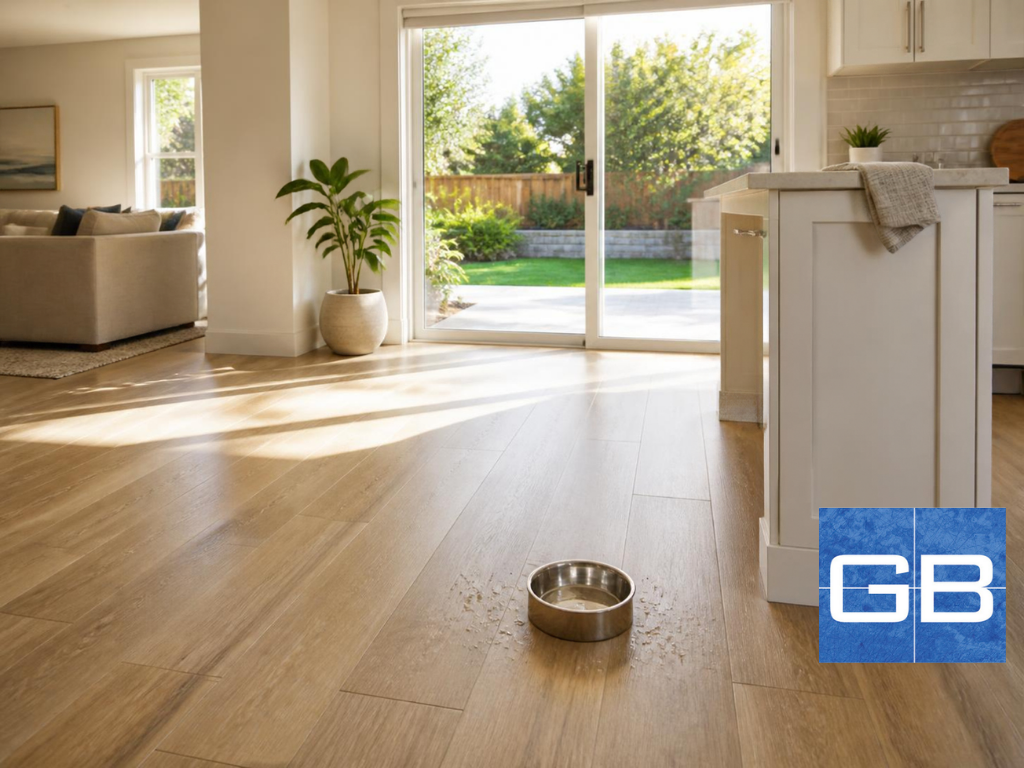
Choose luxury vinyl plank (LVP) where water can sit on the floor or rise from below: full bathrooms, laundry rooms and concrete slabs that test damp. Choose water-resistant laminate where spills get wiped up quickly and you want a harder, more wood-like surface, such as living rooms, bedrooms and halls.
Kitchens can go either way. The deciding question is where water will actually reach your floor.
Around Roseville and Granite Bay, two local factors can tip the call. Long, sunny summers are hard on vinyl, and concrete slabs are hard on laminate. This guide covers both, using manufacturer warranties and installation guides, industry test standards, and local climate and housing data.
The short answer, room by room
Start here if you're planning a specific room. Each recommendation is explained further down.
| Room or situation | Better fit | Why |
|---|---|---|
| Full bathroom | LVP | Water sits at the tub and shower. Laminate needs silicone at every edge to qualify. |
| Laundry room | LVP | Washer and supply-line leaks can sit unnoticed. |
| Kitchen | Either | Spills get wiped up, but dishwasher and ice-maker drips can reach the seams. |
| Powder room | Either | Mostly splashes, with no tub or shower. |
| Entry from the garage or backyard | LVP or waterproof laminate | Wet shoes, dripping dogs and rain at the door |
| Living room, bedrooms and halls | Laminate (LVP works too) | A harder surface resists scratches, and water is rare. |
| Sunroom or a room with big west-facing glass | Depends on the room | Check vinyl's heat limits and laminate's humidity range. |
| Any room over a damp concrete slab | LVP | Vinyl tolerates more slab moisture than laminate. |
| A home with dogs | Either, but read the warranty | Laminate resists claws better. Vinyl handles accidents. Pet coverage varies. |
What's the difference between laminate and LVP?
Both are floating plank floors printed to look like wood or stone. The difference is the core underneath the picture.
- Laminate has a clear, hard wear layer over a photo layer, pressed onto a core of high-density fiberboard (HDF). HDF is made from wood fibers, so it swells if water gets into it, usually through the seams and cut edges.
- Luxury vinyl plank has a vinyl wear layer over a printed film, on a plastic-based core that doesn't absorb water. Rigid-core LVP comes in two main types. SPC (stone plastic composite) is dense and firm, and WPC (wood plastic composite) has a foamed core that feels a little softer.
Everything else follows from those cores. Laminate's water story is about keeping water out of its edges. Vinyl's is about what happens around and under a plank that water can't hurt.
Vinyl is also far more common. Luxury vinyl sales reached $7.4 billion in 2025, more than six times laminate's $1.1 billion, according to Floor Covering News. Laminate sales fell 3.2% that year.
You can compare both in our laminate and luxury vinyl collections, including SPC rigid-core vinyl and the softer WPC vinyl plank.
Where will water reach your floor? The Spill, Seam or Slab test
Room names can mislead. A kitchen with a slow dishwasher leak needs a different floor than a kitchen where the worst that happens is a dropped glass.
So before you choose, ask where the water will come from:
| Water source | What it looks like | What handles it | What to check |
|---|---|---|---|
| Spill: on top, wiped up within hours | A dropped glass, a tipped dog bowl, cooking splashes, wet shoes | Water-resistant laminate, waterproof laminate or LVP | How the warranty defines "promptly" |
| Seam: sits long enough to reach the joints and edges | An overnight dishwasher drip, a pet accident while you're at work, splashing at a tub, rain blowing in at a slider | LVP, or waterproof laminate installed with the maker's sealant | Whether the warranty covers standing water, steam mops and pet urine |
| Slab: comes up from below | A damp concrete slab, a leaking pipe under the floor, a flood | No floor's warranty. LVP tolerates a damper slab, but the source still has to be fixed. | A slab moisture test compared with the maker's limit |
Water problems are common enough to plan for. Nationally, about 1 in 67 insured homes files a water damage or freezing claim each year, and those claims average $15,400, according to the Insurance Information Institute's 2019 to 2023 data.
If your answer is mostly Spill, laminate is on the table. If it's Seam, lean toward waterproof luxury vinyl plank or a waterproof laminate with sealed edges. If it's Slab, fix the moisture first, then choose.
Is water-resistant laminate the same as waterproof laminate?
No. Both have wood-fiber cores. The labels describe how well the surface and joints hold off water, and how much the warranty promises.
There's a real test behind "water-resistant"
The North American Laminate Flooring Association (NALFA) publishes a standing-water test for laminate called the Surface Swell Test.
A lab clicks three pieces of laminate together into a T-shaped joint and seals a 4-inch ring over it. Then it pours in 100 milliliters of dyed water, about 3/8 inch deep, and leaves it for 24 hours.
To earn NALFA's certification, the joint has to look close to unchanged after drying, with a grade of 2 or better on a 5-point scale. The measured swell has to average 0.3 millimeter or less, about the thickness of three sheets of printer paper.
The certification is optional, and only laminate that already meets NALFA's full performance standard (ANSI/NALFA LF-01) can apply. So the words on the box aren't proof. Ask whether the product has passed NALFA's Surface Swell Test or the equivalent ISO 4760 test.
Same brand, two very different promises
Mannington's laminate warranty shows how far apart the two labels can be:
- Restoration Collection with SpillShield Plus, sold as waterproof, won't be damaged by topical spills removed "within a reasonable period of time." Residential steam mops are allowed. It can go in a full bathroom if silicone sealant runs along every wall, tub and shower, and any plank cut in a wet area gets sealed.
- Charter Collection, sold as water-resistant, requires spills to be removed "promptly." Its 10-year water warranty excludes wet mopping, steam mopping and pet urine.
Both are laminate, and both carry a water warranty. One allows a steam mop and a full bathroom, while the other excludes steam mopping and pet urine.
You can see Mannington's Restoration laminate in our collection.
What does a "waterproof" flooring warranty actually cover?
It covers water from above that's cleaned up in time. None of the warranties we reviewed covers water from below, and none covers a flood.
Mohawk's RevWood Plus laminate warranty shows how the fine print works. It treats the flooring and its sealant as one "waterproof flooring system," allows residential steam mops, and covers pet vomit, urine and feces under its All Pet Plus terms.
It also spells out what it won't cover:
- Flooding, standing water, leaking pipes and appliance leaks
- Water or moisture trapped beneath the floor, including hydrostatic pressure, which is moisture pushed up from below
- Moisture left on the floor around the wall base, transitions and trims
Vinyl plank has similar limits. Mannington's installation guide for its ADURA Max vinyl says its warranties don't cover mold discoloration, flooding, leaking plumbing or appliances, or water that comes in through sliding glass doors.
Three words to search for
Before you buy any water-rated floor, open the warranty and search for three words: standing, steam and urine. Those answers tell you more than the label on the box.
The warranty stays with you, not the house
Mannington's laminate water warranties apply only to the first owner and first installation, and they can't be transferred. Mohawk's RevWood Plus warranty applies only to the buyer named on the purchase documents.
So if you're choosing a floor partly for resale, don't count on the warranty as a selling point. The next owner won't get it.
"Lifetime" can mean prorated
Read the coverage schedule, not just the headline. Mohawk's RevWood Plus carries a limited lifetime warranty, but the material coverage is prorated: 100% for the first six years, 90% through year 10, then stepping down each year to 10% in year 20.
Is LVP waterproof underneath?
No. The planks are waterproof, but the subfloor under them isn't. Water that gets beneath a vinyl floor can damage the subfloor and feed mold, and warranties exclude it.
That makes the slab or subfloor as important as the plank. One manufacturer's own guides show how differently its laminate and vinyl treat what's underneath:
| Requirement | Mannington Restoration laminate | Mannington ADURA Max vinyl |
|---|---|---|
| Slab moisture, calcium chloride test (ASTM F1869) | 5 lbs or less | 8 lbs or less |
| Slab moisture, in-slab humidity probe (ASTM F2170) | 75% or less | 85% or less |
| Subfloor flatness | Within 1/8 inch over 6 feet | Within 3/16 inch over 10 feet |
| Room conditions | 65 to 90°F and 30 to 65% humidity for the life of the floor | Never below 55°F or above 140°F |
| Longest run without a transition break | 55 feet, or 3,000 sq ft | 50 feet, or 2,500 sq ft |
| Expansion gap at the walls | 5/16 inch | 1/4 inch |
| Plastic sheeting | Use an appropriate laminate underlayment over hard surfaces | Don't lay 6-mil poly directly under the floating planks |
Calcium chloride results are in pounds per 1,000 square feet per 24 hours. Sources: Mannington's Restoration laminate installation guide (rev. April 2023) and ADURA Max installation guide (rev. May 2024).
The takeaways:
- Vinyl tolerates a damper slab. An 85% reading passes for ADURA Max but fails for the laminate.
- Laminate needs a flatter floor. Its tolerance is tighter over a shorter distance.
- Plastic sheeting isn't a universal fix. Mannington tells installers not to lay 6-mil poly directly under its floating vinyl. Both guides instead call for a vapor retarder beneath the slab itself.
Whoever installs your floor, including our installation team, should test the slab and compare the reading with the limit for the exact product you're buying.
What changes in kitchens and entries?
Kitchens and entries are where the Spill, Seam or Slab test gets put to work. Most of their water arrives as spills, but a slow appliance leak or rain at a door turns it into a seam problem.
Kitchens
Floating floors have to stay free to move. Mannington's ADURA Max guide says not to install cabinets or kitchen islands on top of the floor, so the planks run around them instead.
That shapes the order of a kitchen remodel. New cabinets and islands go in first, and the floating floor goes in after.
If you choose waterproof laminate, the edges around the sink, dishwasher and refrigerator need extra care. Mannington's waterproof laminate warranty requires any plank cut in those spots to be sealed with its applicator solution or silicone.
Entries and sliding doors
Sacramento Executive Airport averages about 18 inches of rain a year, and more than 80% of it falls from November through March. Winter storms are when rain blows in at a slider and sits at the threshold.
Neither floor's warranty is built for that. Mannington's ADURA Max guide excludes water that comes in through sliding glass doors, and its laminate guide calls for 100% silicone in the expansion gaps around exterior doors.
Mohawk's RevWood Plus warranty even requires a suitable mat at entrance doors to keep sand and grit off the floor. At a busy back door, the mat and a quick wipe after storms matter as much as the plank.
What local homes mean for your choice
National comparisons stop at the plank. Around Roseville and Granite Bay, the house around the floor matters just as much: what it's built on, how much sun it gets and how dry the air runs.
Slab or crawl space? It depends on when your home was built
New homes in the West are almost all built on slabs. In 2024, 89.9% of new single-family homes started in the Pacific states sat on a slab, compared with 73% nationwide, according to the National Association of Home Builders (NAHB).
That wasn't always the case. NAHB notes that the Pacific region historically led the country in crawl-space foundations, with a sharp drop only over the past decade.
Most local homes were built before that shift. Census estimates put the median year built at 1980 in Loomis, 1987 in Granite Bay, 1997 in Folsom, 1998 in Roseville and Rocklin, 2002 in El Dorado Hills and 2005 in Lincoln.
So don't assume your floor sits on concrete. Check first, because the prep is different:
- On a slab, the concern is moisture coming up through the concrete. California's green building code now requires new slab foundations to have a capillary break, typically 4 inches of clean gravel under a 6-mil vapor retarder. A slab poured before that rule may not have one, which makes a moisture test even more important.
- Over a crawl space, the planks sit on a wood subfloor. Both Mannington guides require that subfloor to be at least 18 inches above the ground, with cross-ventilation and a vapor barrier over the soil. For laminate, the wood subfloor's moisture content can't exceed 12%.
Older floors: you may not have to tear them out
Many local homes are old enough that their original floors deserve a careful look. About half of the homes in Loomis and 39% in Granite Bay were built before 1980, according to Census estimates.
The EPA notes that asbestos can be found in older vinyl floor tiles, the backing of sheet vinyl and flooring adhesives. It advises against sanding or leveling that material, and says that when asbestos flooring needs replacing, the new floor should go over it if possible.
Floating floors make that easier. Mannington allows its laminate over existing vinyl (though not loose-lay or multiple layers), wood and ceramic tile with leveled grout. ADURA Max can go over most hard floors that are non-cushioned, fully adhered and a single layer, but never over old asphalt-based cutback adhesive.
If you're not sure what's under your current floor, have a trained professional test it before anyone scrapes or sands it.
Sun and heat test vinyl
Summers here are long and bright. At Sacramento Executive Airport, July gets 97% of its possible sunshine, and the year averages 186 clear days, according to NOAA's 1991 to 2020 climate normals.
The same station averages about 76 days a year at 90°F or hotter. Downtown Sacramento hit 100°F on a record 45 days in 2024, beating the previous record of 44 set in 2022.
Heat and sun are vinyl's weak spot. Mannington's ADURA Max guide says to close curtains or blinds where extreme sunlight hits the floor, and warns that heat and sunlight together can cause fading, discoloration or thermal expansion.
The same guide says the floor shouldn't be exposed to temperatures above 140°F.
Laminate warranties handle sun differently. Both Mannington's and Mohawk's laminate warranties say the floor will resist fading from sunlight.
If you're flooring a room with big west-facing sliders, skylights or a sunroom, plan window coverings from the start. Then check the heat limits of the exact vinyl you're considering.
Dry summers and damp winters test laminate
Laminate's weak spot is humidity. Mannington requires its laminate to stay between 65 and 90°F and 30 to 65% relative humidity for the life of the floor, and Mohawk's RevWood Plus warranty rules out damp, humid or extremely dry areas.
Outdoor air here swings across that whole range. At Sacramento Executive Airport, relative humidity averages about 30% on July afternoons and 84% across a typical January day.
A closed, climate-controlled house keeps indoor conditions far steadier than that. Laminate needs a second look in rooms that follow the outdoor air, such as sunrooms, garage conversions and second homes closed up for the summer with the air conditioning off.
California's indoor air rules cover both floors
California set the bar for laminate cores. HDF is a composite wood product, and the EPA's national formaldehyde limits (TSCA Title VI) are set at the same levels as California's CARB Phase 2 rule.
Since March 22, 2019, covered products made in or imported into the U.S. must be labeled TSCA Title VI compliant. NALFA's LF-01 standard also requires third-party proof that a laminate's core meets both rules.
For vinyl, look for the FloorScore seal. It means SCS Global Services has independently certified that the product meets the emissions criteria of California's Section 01350 program.
New homes in California have to meet these rules. Under the 2025 California Green Building Standards Code, at least 80% of the floor area receiving resilient flooring must meet the state's emissions standard, and composite wood must meet the formaldehyde limits.
Those requirements apply to new homes and to additions that add conditioned space, not to a simple floor replacement. You can still ask for the same labels on any floor you buy.
Do you need a permit to replace flooring?
Usually not. Roseville's 2025 list of work that doesn't need a building permit includes "painting, papering, tiling, carpeting, cabinets, counter tops and similar finish work."
If your project goes further, such as moving plumbing for a laundry room or taking out a wall to open up a floor plan, check with the City of Roseville's Building Division. In Granite Bay, check with Placer County Building Services.
Which is more durable for busy households and pets?
Laminate's hard wear layer resists scratches well. Vinyl handles water and pet accidents better. How well either one resists dents depends on the specific product.
What the durability numbers mean
- Laminate: NALFA's LF-01 standard sets minimum wear resistance by use level, from 1,500 test cycles for residential floors to 6,000 for heavy commercial. Many boxes also show an AC rating from AC1 to AC5, and a higher number means a tougher surface.
- LVP: Durability is usually quoted as wear-layer thickness in mils. A mil is a thousandth of an inch, so a 20-mil wear layer is 0.02 inch, about half a millimeter.
Thickness isn't the whole story. In Consumer Reports' testing, two vinyl floors with the same 20-mil wear layer landed far apart: one scored excellent for foot traffic, and the other ranked below the middle.
Floors for dogs
Dogs test a floor in two ways, with claws and with accidents. Laminate's harder surface stands up better to claws, while vinyl planks shrug off accidents. Urine that sits can still reach the seams and the subfloor under either one.
If you choose laminate, read the pet terms. Mohawk's RevWood Plus warranty covers pet urine, while Mannington's Charter warranty excludes it.
If accidents are your main worry, start with our pet-friendly luxury vinyl.
How do laminate and LVP feel and sound underfoot?
Laminate feels firmer and more like wood. It can sound hollow or clicky underfoot, and a good underlayment helps quiet it.
LVP feels softer and a little warmer, especially WPC with its foamed core. Many rigid-core planks come with a pad already attached, including Mannington's ADURA Max.
Feel is personal, so compare samples in person, ideally in your socks.
Does laminate or LVP cost more in 2026?
Their prices overlap. Consumer Reports puts laminate at $2 to $7 per square foot and vinyl at $3 to $5, for materials only.
The installed price often depends more on your house than on the plank:
- Slab moisture. A damp slab may need drying time or a moisture-mitigation system before either floor goes down.
- Flatness. Laminate's tighter tolerance can mean more floor leveling.
- Underlayment. Laminate needs an appropriate underlayment over hard surfaces, while many vinyl planks have one attached.
- Long runs. Open floor plans longer than about 50 to 55 feet need a transition break, depending on the product.
- Wet-area sealing. Waterproof laminate in a bathroom or laundry room needs silicone at the edges.
Tariffs are the 2026 wild card. Floor Covering News reports that reciprocal duties on imported laminate can reach 20%, depending on the country of origin. Mohawk makes its RevWood laminate at plants in North Carolina.
The fairest comparison is the same rooms priced both ways, prep included. If the floor you want stretches the budget, our flooring financing options can help.
Frequently asked questions
Can you steam mop laminate or LVP?
It depends on the product's warranty. Mannington's Restoration laminate and Mohawk's RevWood Plus allow residential steam mops, while Mannington's water-resistant Charter line excludes steam and wet mopping. For vinyl, follow the maker's care guide.
Can waterproof laminate go in a full bathroom?
Some lines allow it. Mannington's Restoration laminate can go in a full bath if silicone runs along every wall, tub and shower. LVP is the simpler choice, and tile is the traditional one, which our porcelain vs. ceramic tile guide covers.
Do laminate and LVP need to acclimate before installation?
Often not, if the house is at normal conditions. Mannington says its laminate doesn't need acclimation under normal conditions, and ADURA Max doesn't need it if the HVAC is running and the planks are within 15°F of the room. Both need time to adjust when storage and site conditions differ a lot.
How do you clean laminate and LVP?
Gently, and by the maker's rules. Mannington says never to wax, polish or use soap on its laminate, and never to seal it after installation. For vinyl, use the cleaner and method in the maker's care guide.
Can laminate or LVP go over radiant floor heat?
Yes, within limits. Mannington's guides for both floors allow hydronic radiant heat as long as the floor's surface stays at or below 85°F.
Choosing between laminate and LVP for your home
Start with the Spill, Seam or Slab test. Choose laminate where water shows up as spills you'll wipe away, choose LVP where it can sit or rise from below, and check the slab before either one goes down.
Then match the floor to the room. Vinyl needs shade from strong sun, and laminate needs steady humidity.
Samples tell you more than photos. Visit our showroom on Sierra College Boulevard to compare laminate and vinyl side by side, or read what local homeowners say about us first.
When you're ready, schedule a free in-home estimate. We'll measure your rooms, look at the subfloor you're starting with and price both options so you can compare.


