


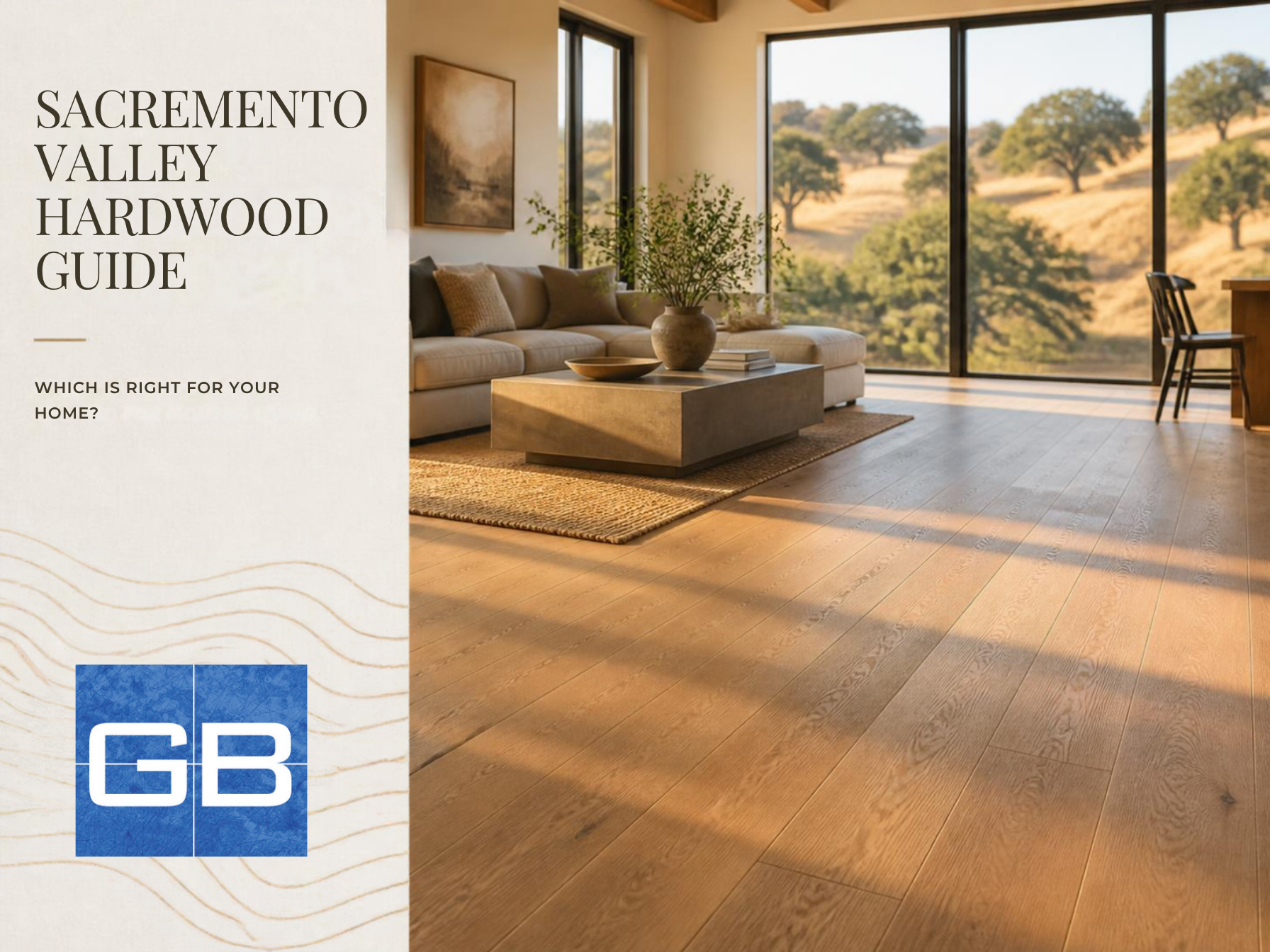
Engineered and solid hardwood are both real wood, and in a Sacramento Valley home the right one usually comes down to three things: how dry your house gets in summer, whether your floor sits on a concrete slab, and how many times you want to sand it down over the years. Solid hardwood is a single piece of wood milled into a board. Engineered hardwood is a real wood surface bonded over a plywood-style core, built so it barely moves when the air changes. For a lot of houses around Roseville, Rocklin and Granite Bay, that stability is exactly why engineered ends up on the floor. Solid still wins in specific cases, though, and the rest of this guide walks through which is which.
We install and refinish both every week across Placer and Sacramento counties, so this is the same conversation we have at the kitchen table when someone is trying to choose. None of it is about one product being "better." It is about matching the board to your climate, your subfloor and your plans for the house.
What's Actually Different Between Engineered and Solid Hardwood?
The difference is in the build. A solid board is one piece of oak, maple, hickory or walnut, three-quarters of an inch thick top to bottom. An engineered board is a thin slice of that same species, called the wear layer, glued over several thinner plies of wood that are stacked with their grain running in alternating directions, much like plywood. That cross-grain construction is the whole point: because each layer pulls against the next, the board expands and contracts far less than a solid plank when the humidity swings. The wood you see and walk on is identical. What sits underneath is what changes how the floor behaves.
Engineered's cross-grain core and solid's single slab of wood behave differently in almost every situation below, so it helps to see the two side by side before we get into the Sacramento Valley specifics.
| Question | Solid hardwood | Engineered hardwood |
|---|---|---|
| What is it? | One solid piece of wood, usually 3/4 inch thick | A real-wood wear layer over a cross-layered core |
| Movement with humidity | More; expands and gaps as the air dries and swells back | Less; the cross-grain core resists seasonal movement |
| Straight over a concrete slab? | Not directly; needs a wood subfloor built over the slab | Yes; can be glued down or floated on the slab |
| Refinishing | Many times; can outlast the homeowner | Once or twice if the wear layer is thick enough |
| Widest planks that behave | Narrower strips are safest in a dry climate | Wide planks stay flatter and are the usual pick |
| Where it shines | Raised-foundation homes you plan to keep for decades | Slab homes, open great rooms, kitchens, radiant heat |
Keep that last column in mind, because the Sacramento Valley leans on it more than most parts of the country. Our climate and the way our houses are built both push in the same direction.
How the Sacramento Valley's Dry Summers Move a Wood Floor
Wood never really stops moving, and our climate makes it move more than most. Wood is what scientists call hygroscopic, a five-dollar word that just means it drinks moisture out of humid air and gives it back to dry air, swelling and shrinking as it goes. The wood-flooring trade has a comfort band for this. The National Wood Flooring Association, the group that writes the installation and maintenance standards most manufacturers build their warranties around, says a wood floor does best when the room stays between 30 and 50 percent relative humidity and 60 to 80 degrees. Live inside that band and the floor is happy. Drift outside it, season after season, and the boards start to work.
Now put that band against a Sacramento summer. NOAA, the federal agency that keeps the nation's long-term climate records, has Sacramento averaging only about 18.5 inches of rain a year, and almost none of it lands in the warm months; the normal rainfall for July is 0.00 inches. Our summers are genuinely arid, closer to Nevada than to anywhere back east, and the air conditioning that runs from June to September pulls indoor air drier still. Then the pattern flips: the rain arrives in winter, the valley fog settles in, and indoor humidity climbs back up. A hardwood floor here spends the year being pulled toward the dry edge of that comfort band in summer and nudged back in winter.
A wide seasonal humidity swing is where solid hardwood shows its one real weakness. According to the NWFA's own numbers, a floor that sees its humidity move by 30 points, say from 30 up to 60 percent, moves enough to change how it looks and performs, and a 5-inch plank shifts more than twice as much as a narrow 2 1/4-inch strip. Across a 10-foot-wide room, that same swing can add up to more than 2 inches of total movement, which is exactly how a solid floor ends up with hairline gaps you can catch a fingernail in every August. It is the most common hardwood complaint we get, and we wrote a whole piece on why hardwood floors start separating if you want the full picture. Engineered board, with its cross-layered core, simply doesn't travel as far, which is why wide-plank looks in dry, swingy climates almost always come in engineered form.
None of this makes solid hardwood a mistake here. It makes humidity something you plan around, with proper acclimation before install, letting the boards sit in the house until they settle to its humidity, and, in a very dry house, a whole-home humidifier to hold the winter and summer numbers closer together. It is the first question worth asking about any wood floor in the valley: how far will this board move, and can the room keep it in its comfort zone?
Why Slab-on-Grade Homes Change the Hardwood You Should Buy
Most homes around Roseville sit on a concrete slab poured right on the ground, and that fact quietly decides a lot about your floor. Building on slab is the western norm rather than a local quirk: the National Association of Home Builders, the trade group that tracks how American houses get built, counts roughly 86.5 percent of new homes in the Pacific region built on slab, with basements almost unheard of. If your home is a typical Placer County build from the last few decades, the subfloor under your carpet or tile is very likely bare concrete.
Concrete matters because it is never truly done releasing moisture, and wood laid over a damp slab will cup and buckle. Before any wood goes down over concrete, the slab gets a moisture test, most often an in-slab humidity reading taken through a probe under the method the industry calls ASTM F2170. The probe sits in a drilled hole for about three days to settle, then reads the humidity deep in the slab; if that number lands above the ceiling the flooring manufacturer sets, the floor waits or gets a moisture barrier first. This is not red tape. It is the single most skipped step behind slab-related wood failures, and it is worth confirming your installer runs it.
Here is where engineered pulls ahead on a slab. Engineered board is built to be glued straight down to concrete or floated over a thin pad, so on a slab home it is often the direct, clean install. Solid hardwood can't be nailed to concrete, so it needs a wood subfloor built on top of the slab first, either a plywood layer or wood sleepers, which raises the floor height, eats into door clearances and adds labor to the bill. That is why, on a slab, the engineered-versus-solid question is often really a question about the total installed cost. The material prices overlap more than people expect; the install method is what moves the number. If you are weighing options, it is worth walking the hardwood we carry with your subfloor in mind, and our team can tell you on a free in-home measurement whether your slab is ready or needs prep.
Will Engineered Hold Up in a Busy Placer County House?
A quality engineered floor takes daily life just as well as solid, because the part you walk on is the same wood. Dents, scratches and wear happen at the surface, and the surface is real oak or hickory in both cases, protected by the same kind of factory finish. Hardness is measured on the Janka scale, a test that presses a small steel ball into the wood and records the force it takes to leave a mark. Red oak scores 1,290 and is the benchmark the whole North American trade compares to; white oak is a touch harder at 1,360, hickory is far tougher near 1,820, and walnut is softer at about 1,010. Pick a harder species and you get a floor that shrugs off the dog's nails and the dining chairs, whether that species arrives as solid or engineered.
One thing surprises people: the hardest woods are not the most stable. The same NWFA guidance that ranks engineered above solid for stability also notes that dense species like maple and Brazilian cherry actually move more with humidity than plain North American oak does. So in a dry, swingy valley climate, chasing the highest Janka number can work against you if you also want a wide, flat, gap-free plank. Oak earns its popularity here honestly: hard enough for a family, stable enough for the weather.
Where solid and engineered really part ways is how many times you can sand them back to new. A solid board is thick enough to be refinished many times, which is how a great-grandmother's oak floor gets brought back to life. Engineered can be refinished too, but only if its wear layer is thick enough to survive the sander. The NWFA's sand-and-finish guidelines draw the line at 3/32 of an inch, about 2.5 millimeters: thinner than that and the floor should stay on the factory finish it came with. A generous 4 to 6 millimeter wear layer can take a light sanding once or twice; a thin veneer can't take one at all. We handle both installation and hardwood refinishing in house, and we walk through that refinish-or-replace decision in more detail if your floors are already showing their age.
When Solid Hardwood Is Still the Better Floor
Solid hardwood is the stronger choice when your home is built for it and you plan to keep it for the long haul. If you have a raised foundation with a crawl space and a wood subfloor, which is common in the valley's older neighborhoods, solid nails straight down the way it always has, no subfloor build-up needed. If you want a floor your kids will refinish in thirty years and hand to their kids, solid's thickness is the whole appeal. And in a narrower strip width, an oak solid floor holds up beautifully against our humidity swings, since the movement that troubles a wide plank is much gentler on a 2 1/4- or 3-inch board. Bedrooms, hallways and formal rooms upstairs, over a wood subfloor, are classic solid territory.
When Engineered Hardwood Is the Smarter Buy in the Valley
Engineered hardwood is usually the smarter buy when the job involves a slab, a wide plank, or a heated floor. On a concrete slab it installs directly, which saves the cost and lost ceiling height of building a subfloor. For the wide, long, low-contrast planks that are on nearly everyone's inspiration board right now, engineered stays flat where a solid version of the same width would fight the dry season. It is also the right answer over radiant heat, which more Granite Bay and El Dorado Hills custom homes are putting in. Radiant is dry heat by nature, and the NWFA both favors the more stable options here, engineered board and narrow planks, and caps the subfloor surface temperature around 85 degrees, with a humidifier often recommended to keep the wood comfortable. Kitchens and open great rooms that flow toward a patio round out the list. If you are leaning this way, our showroom staff can pull engineered lines in the species and plank width you're after and match them to your rooms.
Engineered Cores, Formaldehyde, and Indoor Air
Because engineered board has a glued-up core, its indoor-air story is worth a quick look, and California already has your back here. The core adhesives in composite wood can give off formaldehyde, so the California Air Resources Board set strict Phase 2 limits on how much they're allowed to emit. Those California limits then became the national rule when the EPA adopted the same levels under a law called TSCA Title VI, and since 2019 composite-wood products, flooring included, have to be certified and labeled as compliant. Solid hardwood skips this question entirely, since there is no core and no glue. For engineered, look for that compliance label, and for the strictest indoor-air bar, a FloorScore mark, the indoor-air-quality certification run by the Resilient Floor Covering Institute with SCS Global Services that tests a floor against 35 separate airborne compounds, formaldehyde among them. Any reputable engineered line sold today should carry both.
Questions We Hear About Engineered vs. Solid Hardwood
Is engineered hardwood real wood?
Yes. The surface you see and walk on is a genuine slice of hardwood, the same oak, hickory or walnut you would get in a solid board. The difference is underneath, where engineered uses a cross-layered wood core instead of one thick piece. Underfoot and to the eye, a good engineered floor and a solid floor of the same species look and feel the same.
Can you refinish engineered hardwood floors?
Sometimes, and it depends on the wear layer. If the real-wood top is at least 3/32 of an inch thick, roughly 2.5 millimeters, the floor can usually take a light sanding, and thicker 4 to 6 millimeter veneers can handle it once or twice. Thinner wear layers can't be sanded and are meant to live on their original finish. Solid hardwood, by contrast, can be refinished many times over its life.
Which lasts longer, engineered or solid?
Both can last for decades, but they get there differently. Solid hardwood can be sanded back to bare wood many times, so it can be renewed almost indefinitely with care. A quality engineered floor lasts just as long day to day and can be refinished a limited number of times, then replaced. In a slab home with big seasonal humidity swings, engineered often holds its looks longer because it moves less.
Is engineered or solid better over a concrete slab?
Engineered is the easier and usually cheaper choice over a slab, because it glues or floats directly onto the concrete after a moisture test. Solid can't go straight onto concrete; it needs a wood subfloor built on top first, which adds height and cost. Since most homes around Roseville are built on slab, this is often the deciding factor.
Does hardwood belong in a Sacramento Valley kitchen?
Hardwood can work in a kitchen, and engineered is the safer bet there. A kitchen sees spills and humidity a bedroom never does, and engineered's stable core handles those swings with less risk of gapping or cupping than a solid plank. Wipe up standing water quickly with either one, since no hardwood loves a puddle, and ask about the finish, which is what actually fends off day-to-day moisture.
Choosing the Right Hardwood for Your Northern California Home
The honest answer to engineered versus solid is that the valley's dry summers, wet winters and slab-built homes tip a lot of local jobs toward engineered, while solid stays the pick for raised-foundation homes and anyone who wants to refinish for generations. The best floor is the one matched to your subfloor, your climate and your plans. The biggest name on the sample board matters far less than how the board will live in your house. You can see how we lay out the full range on our hardwood flooring overview, from budget-friendly engineered to solid exotics. When you are ready to put real options on your floor, request a free in-home estimate and we will measure your rooms, check your subfloor, and help you choose a hardwood that still looks right ten summers from now.


