


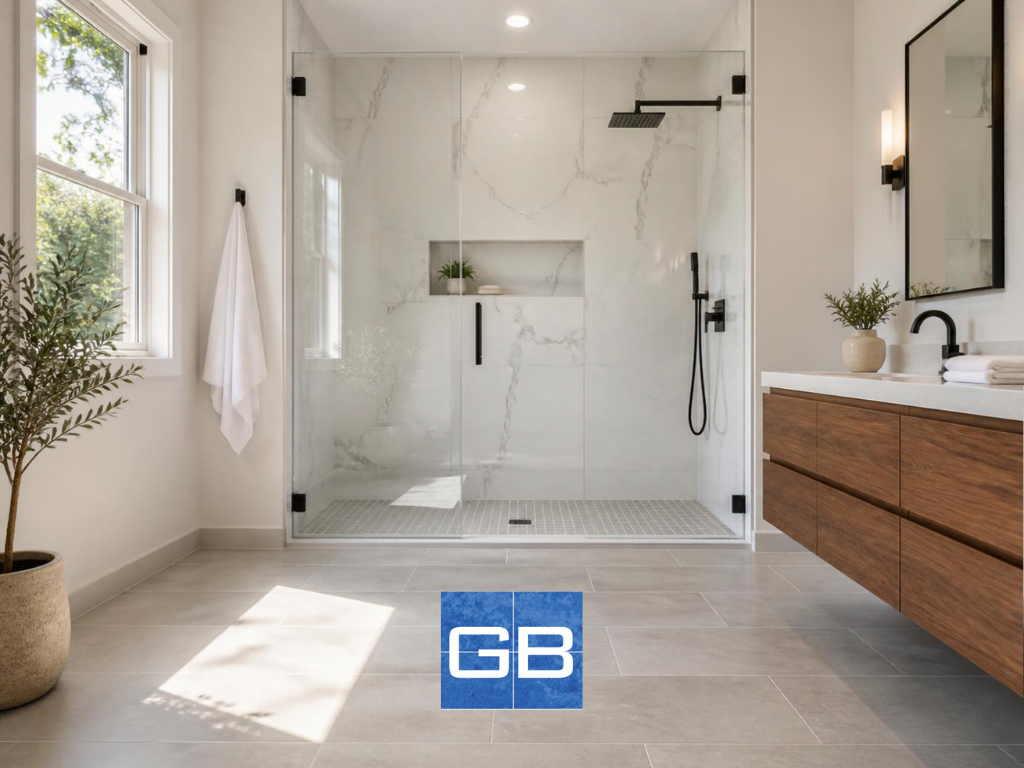
Choose porcelain for floors, shower floors and anything outdoors. Choose ceramic for walls and backsplashes, where it holds up just as well and usually costs less.
That simple split covers most kitchen and bathroom remodels. The rest of this guide explains why it works, how to check what you're actually buying, and what local heat, frost, water and housing mean for your tile in Roseville, Granite Bay and nearby towns.
Quick answer: porcelain or ceramic for each surface
Use this table as a starting point. Each recommendation is explained further down.
| Surface | Choose | Look for |
|---|---|---|
| Bathroom floor | Porcelain | A matte or textured finish with a wet DCOF of 0.42 or higher |
| Shower floor | Porcelain, or a mosaic rated for shower floors | A shower-floor rating, and small mosaics for a center drain |
| Shower walls | Either one | A waterproof membrane behind the tile |
| Bathroom walls and tub surrounds | Ceramic (porcelain works too) | A wall rating |
| Kitchen floor | Porcelain | A floor rating, plus color-body or through-body porcelain to hide chips |
| Kitchen backsplash | Ceramic (or porcelain to match a floor) | Any finish you like |
| Laundry or mudroom floor | Porcelain | A floor rating and a wet DCOF of 0.42 or higher |
| Patio or pool deck | Porcelain rated for exterior use | A freeze rating and a wet DCOF of 0.60 or higher |
DCOF is the slip-resistance number on a tile's spec sheet. It's measured on wet tile, and a higher number means more grip.
What's the difference between porcelain and ceramic?
Porcelain is a type of ceramic tile, not a separate material. What sets it apart is how much water the tile's body absorbs.
To be sold as porcelain in the U.S., a tile has to absorb 0.5% or less of its weight in water in a lab test called ASTM C373. That limit comes from the national tile standard, ANSI A137.1.
Porcelain gets there with finer clays and a hotter firing. The result is a denser, harder tile with very few pores.
Tile boxes sort all ceramic tile into four groups by absorption:
| Group on the label | Water absorbed | What it usually is |
|---|---|---|
| Impervious | 0.5% or less | Porcelain |
| Vitreous | More than 0.5%, up to 3% | Dense ceramic, including some floor mosaics |
| Semi-vitreous | More than 3%, up to 7% | Mid-range ceramic |
| Non-vitreous | More than 7% | Glazed wall tile |
The Face-or-Body Test
Most glazed tile has two parts. There's the glazed face you see, and there's the clay body underneath.
The glaze sheds water on porcelain and ceramic alike. What porcelain improves is the body, which is stronger, harder and far less absorbent.
So ask one question about every surface in your remodel: is the tile's face doing the work here, or its body?
- Face surfaces are walls, backsplashes and tub surrounds. Water splashes them and dries, and nothing heavy lands on them. Ceramic is all you need.
- Body surfaces are floors, shower floors, patios and pool decks. Tile here carries weight, takes impacts, sits in water and, outdoors, can freeze. Choose porcelain.
There's one twist. Slip resistance comes from the face, so a floor needs a good face as well as a strong body. That means a matte or textured finish with enough grip when it's wet.
In practice, you'll be shopping porcelain tile for your floors and ceramic tile for your walls and backsplash.
Most homeowners already split things this way. Houzz's 2025 bathroom survey found porcelain on 39% of remodeled shower floors and ceramic on 26%. Its 2026 kitchen study found the reverse on backsplashes, with ceramic at 49% and porcelain at 23%.
What the spec sheets show
Daltile's Perpetuo collection makes the test easy to see. It sells porcelain floor tile and glazed ceramic wall tile in matching marble looks, and it's part of our Daltile selection.
Here's how the two compare on Daltile's 2024 spec sheet:
| Perpetuo porcelain floor tile | Perpetuo ceramic wall tile | |
|---|---|---|
| Water absorption | Under 0.5% | Under 20% |
| Breaking strength | Over 275 lbs of force | 120 to 230 lbs of force |
| Scratch hardness (Mohs scale of 1 to 10) | 8 in matte, 6 in polished | 4 to 6 |
| Rated for wet, level floors | Matte finish only | No |
Daltile rates the porcelain for floors and the ceramic for walls. That's the Face-or-Body Test inside a single product line.
Its Color Wheel Classic ceramic follows the same pattern. It's rated for walls and countertops, but not for floors, outdoor floors or shower floors.
How to tell if a tile is really porcelain
A "porcelain" label isn't a guarantee. TCNA, the tile industry's trade group, reports many cases of tile sold as porcelain that doesn't meet the standard.
Two quick checks will tell you what you're getting:
- Read the absorption line on the spec sheet. It should say 0.5% or less under ASTM C373.
- Look for the PTCA mark. The Porcelain Tile Certification Agency tests tile against the 0.5% limit. If there's no mark, ask the seller for test results.
Lookalikes are the reason to check. Daltile's Portfolio line sells a porcelain floor tile (under 0.5%) and a glazed ceramic mosaic (under 3%) in matching colors.
Skip the old trick of checking the back of the tile. Porcelain can be made from red clay, so a red back doesn't rule it out and a white back doesn't prove it.
How deep does the color go?
Porcelain comes in three types. The difference shows up the day something chips it.
| Type | How it's colored | What a chip shows | Best for |
|---|---|---|---|
| Glazed porcelain | A printed glaze over a plain porcelain body | The body's color, which may not match | Bathroom floors, walls and lighter-traffic floors |
| Color-body porcelain | The body is tinted to match the surface | A similar color that's hard to spot | Kitchens, entries and busy family floors |
| Through-body porcelain | The same color runs all the way through | The same color as the surface | The heaviest wear |
| Glazed ceramic (for comparison) | A glaze over a red or white clay body | The clay underneath | Walls, backsplashes and floors it's rated for |
Bathroom floors
Pick a matte or textured porcelain with a wet DCOF of 0.42 or higher.
DCOF measures how much grip a wet surface gives. Using the ANSI A326.3 test, TCNA treats 0.42 as the minimum for level indoor floors that people walk on when wet.
It's a minimum, not a guarantee. TCNA notes that other factors play into slips, and the number doesn't apply to ramps or sloped floors.
Finish matters as much as material. Perpetuo's matte porcelain is rated for wet, level floors, but the polished version of the same tile isn't.
Also check the maker's floor rating. Daltile rates floor tile from 1 to 4. A 1 suits bathrooms, and a 4 can handle any home or commercial space.
Showers
Shower walls: the membrane does the waterproofing
No tile is waterproof on its own. The glaze repels water, but cement grout lets some through.
What keeps water out of your walls is the waterproof membrane behind the tile. Look for one that meets ANSI A118.10, or use a vapor retarder, the other accepted option.
With that in place, glazed ceramic works just as well as porcelain on shower walls.
Shower floors: porcelain or a rated mosaic
The shower floor is a face surface and a body surface at once. You stand on it barefoot and wet every day.
Use porcelain or a mosaic the maker rates for shower floors, with a wet DCOF of 0.42 or higher. The mosaic can be ceramic. Daltile's Portfolio shower-floor mosaic, for example, is a glazed ceramic that absorbs under 3%.
Your drain decides how large the tile can be:
- Center drain. The floor slopes down from four sides, usually 1/4 to 1/2 inch per foot. Only small mosaics can follow those angles, which is why Daltile rates only mosaics for these floors in its Perpetuo and Portfolio lines.
- Linear drain. The floor slopes one way toward a drain along the wall, so larger tile can work. Daltile raises its wet DCOF target to 0.60 for these floors.
Kitchen floors
A kitchen floor is a body surface even when it's dry. It takes dropped pans, dragged chairs and tracked-in grit every day.
Porcelain's denser body handles that better, as the breaking-strength numbers in the Perpetuo table show.
Color-body or through-body porcelain is worth the step up here. Sooner or later something heavy will hit a kitchen floor, and these types keep the chip from standing out.
Don't shop by PEI rating
Many buying guides treat the PEI rating as a measure of porcelain toughness. It isn't one.
The rating comes from a test of how well a glaze resists visible wear, graded from Class 0 to Class 5. It only applies to glazed tile, and unglazed porcelain is tested a different way.
Even the name adds confusion. PEI stands for the Porcelain Enamel Institute, which isn't a tile organization.
For a kitchen floor, the manufacturer's floor rating is the better guide.
Kitchen backsplashes
A backsplash is a pure face surface. It gets splashed and wiped but never walked on, which is why ceramic is the usual pick.
In Houzz's 2026 kitchen study, based on a survey of 1,780 homeowners, tile covered 72% of new backsplashes, and ceramic was the most popular tile.
Glossy finishes are fine because walls don't need slip resistance. Wall tile can also go in with very thin grout lines. Daltile allows joints as narrow as 1/16 inch on its 12x24 Perpetuo wall tile.
Porcelain makes sense on a backsplash when you want it to match a porcelain floor or countertop. For something different, look at glass tile or natural stone such as marble and travertine.
What local homes need from tile
National tile advice misses several things that matter around Roseville. Summers here are long and hot, the foothills see more freezing nights than the valley floor, the water is very soft, and much of the housing went up in the same 30-year stretch.
Each of those changes how you should choose and install tile.
Summer heat and sun-facing floors
Sacramento Executive Airport averages 75.6 days a year at 90°F or hotter, and 14 days at 100°F or more. Those figures come from NOAA's 1991 to 2020 climate normals.
July shows the real stress. The average high is 92.6°F and the average low is about 59°F, a daily swing of more than 30 degrees.
Tile in direct sun rides that cycle every day. Floors beside sliding doors, under skylights or in sunrooms heat up in the afternoon and cool down overnight.
Tile and the concrete under it expand as they warm and shrink as they cool. If nothing takes up that movement, pressure builds until tiles crack, pop loose or lift into a ridge. Installers call that tenting.
The fix is movement joints. These are flexible, caulked joints that replace grout at set intervals.
TCNA's movement-joint guideline (EJ171) allows them up to 25 feet apart in most indoor rooms. Where tile gets direct sun, the limit drops to 12 feet. Outdoors, it's 8 to 12 feet.
This applies to porcelain and ceramic alike. If you're tiling a sunny room, ask your installer where the movement joints will go before work starts.
Freezing nights, from the valley to the foothills
Winters here are mild, but they aren't frost-free. Sacramento Executive Airport averages 15.4 nights a year at or below freezing.
The count rises toward the foothills. Auburn averages 19.6 freezing nights a year, so towns between the valley floor and Auburn, like Loomis and Granite Bay, likely fall somewhere in that range.
Freezing matters because of absorption. Water that soaks into a tile's body expands when it freezes, and repeated cycles can crack or flake the tile.
That's why outdoor tile should be porcelain rated for exterior use. Daltile, for example, allows its Perpetuo porcelain floor tile outdoors even in freezing climates, but limits the ceramic wall and mosaic tile in the same line to climates that don't freeze.
For a patio or pool deck, two more things matter:
- Grip. Look for a wet DCOF of 0.60 or higher. Daltile uses that target for patios and pool decks.
- Full mortar coverage. The installation standard calls for mortar under at least 95% of each outdoor tile, which leaves fewer hollow spots underneath.
If you want tile to flow from a family room out to the patio, choose an exterior-rated porcelain for both spaces from the start.
Soft water, and what it means for glossy tile
Hard water leaves white mineral spots on glossy tile, glass and fixtures. Most homes in this area are in luck.
The U.S. Geological Survey calls water soft at 60 milligrams per liter of hardness or less. From 61 to 120 counts as moderately hard, and above 180 is very hard.
Roseville's treated water from Folsom Lake measured 26 milligrams per liter in the city's 2025 water quality report. That's comfortably soft.
Granite Bay's water is softer still. The San Juan Water District, which supplies homes across Granite Bay, draws all of its water from Folsom Lake. It reports hardness of 1.37 grains per gallon, about 23 milligrams per liter, and calls it ultra soft.
There's one caveat. Roseville's groundwater wells run harder, averaging 95 milligrams per liter in the same report, with some samples as high as 280. If your home is on a private well, test the water before you choose high-gloss tile for a shower.
For homes on Folsom Lake water, glossy ceramic, glass tile and polished finishes are practical choices. Grout still needs the most attention, which the care section below covers.
Homes built from 1980 to 2009: slabs, joints and flatness
Much of the housing around Roseville went up in a single 30-year stretch. Census estimates show how concentrated it is:
| Community | Median year built | Built 1980 to 2009 | Built before 1980 |
|---|---|---|---|
| Roseville | 1998 | 62% | 17% |
| Rocklin | 1998 | 67% | 15% |
| Lincoln | 2005 | 75% | 8% |
| Folsom | 1997 | 72% | 13% |
| El Dorado Hills | 2002 | 66% | 12% |
| Granite Bay | 1987 | 54% | 39% |
| Loomis | 1980 | 45% | 50% |
Source: U.S. Census Bureau, American Community Survey 2020 to 2024 five-year estimates.
If your home dates from that era, the tile you're replacing may well be the original.
Slab foundations are also the norm for new homes in the West. In 2024, 89.9% of new single-family homes started in the Pacific states were built on a slab, compared with 73% nationwide, according to the National Association of Home Builders.
Tiling over a slab brings three things to check, especially before you choose a large porcelain:
- Control joints. The saw-cut lines in a slab need a matching movement joint in the tile above, or a crack isolation membrane its maker approves for shifting the joint.
- Cracks. A crack isolation membrane (ANSI A118.12) can keep small slab cracks from reaching the tile. It won't handle cracks where one side has moved up or down.
- Flatness. Tile with any edge of 15 inches or longer needs a flatter floor, as the installation section explains.
Whatever your home's age, have the floor checked before you commit to a 24x48 tile. Leveling can change the budget more than the choice between two tiles.
Bathrooms built for the long run
Granite Bay's median resident age is 47.2, with El Dorado Hills and Loomis close behind at 45.7 and 45.5. Roseville's is 40.2, according to the same Census estimates.
The area is also home to two large 55-and-over communities. Sun City Roseville has 3,110 homes, and Sun City Lincoln Hills has 6,703 single-family homes plus 80 condos.
That makes slip resistance worth extra thought, because bathroom injuries climb with age. A CDC study of 2008 emergency room visits found that falls caused 81.1% of nonfatal bathroom injuries.
The same study found that injuries in and around tubs and showers rose from 49.7 per 100,000 people aged 15 to 24 to 200.2 per 100,000 among people 85 and older.
If you're remodeling for the long run, build safety into the tile plan:
- Choose matte or textured porcelain for bathroom floors, with a wet DCOF of 0.42 or higher for the exact finish.
- Keep polished porcelain off any floor that gets wet.
- Use a rated mosaic on a center-drain shower floor, or tile that meets the 0.60 target with a linear drain.
- Plan the drain and tile together if you want a curbless shower. Houzz found curbless showers in 20% of 2025 bathroom remodels.
- Decide where grab bars will go before the walls are tiled. The CDC study recommends grab bars and non-slip strips in tubs and showers.
Permits for a shower remodel
Tub-to-shower conversions are popular. Houzz found that 82% of homeowners who removed a tub in 2025 used the space to enlarge the shower.
Roseville updated its bathroom remodel handout on January 1, 2026, for the 2025 California codes. For a shower, it lists:
- At least 1,024 square inches of floor inside the shower, with room for a 30-inch circle
- A door at least 22 inches wide
- A hard, nonabsorbent wall surface at least 6 feet above the floor
- A 2-inch drain trap for a single-head shower
- A pressure-balanced valve limited to 120°F
- A showerhead rated at 1.8 gallons per minute or less
- Safety glass in the enclosure and an exhaust fan vented outdoors
None of these rules require porcelain. Roseville homeowners apply through the city's Building Inspection Division. In Granite Bay, permits go through Placer County Building Services, which has an office in Auburn.
Settle the shower's size and drain before you choose tile. Together, they decide whether you'll be picking from mosaics or larger floor tile.
What porcelain asks of the installation
Porcelain's dense body, and the large sizes it often comes in, raise the bar for installation. Any installer, including our installation team, should be able to explain how they'll handle each of these:
- Mortar. Porcelain needs a polymer-modified thin-set, sometimes called latex-modified. Look for ANSI A118.4 on the bag, or A118.15 for large, heavy tile.
- Flatness. For tile with any edge of 15 inches or longer, ANSI A108.02 allows no more than 1/8 inch of variation over 10 feet, or 1/16 inch over 24 inches.
- Coverage. Mortar should cover at least 80% of each tile on dry floors and 95% in showers and outdoors, with every corner supported.
- Layout. Long tiles have a slight natural bow, so the offset is capped at 33% when the offset side is longer than 15 inches. That usually rules out a classic 50% brick pattern for wood-look planks.
- Grout joints. The minimum is 1/8 inch for rectified tile, whose edges are ground square after firing, and 3/16 inch for calibrated tile.
- Cutting. Porcelain is harder to cut and drill, which adds time around outlets, vents and plumbing.
Large tile isn't only porcelain. Ceramic wall tile comes in 12x24 too, and the size-based rules apply to either material.
Where porcelain's extra cost comes from
Porcelain usually costs more per box than ceramic. The box is only part of the bill, though.
Porcelain can add cost in a few places:
- The tile itself, especially large-format and color-body porcelain
- Setting materials, since porcelain needs a polymer-modified thin-set
- Floor prep, because large tile may need the floor leveled first
- Labor, from harder cutting and drilling and the layout limits on long tile
Waterproofing costs the same either way, since every shower needs a membrane.
Prices can also shift with trade policy. About 72% of the tile sold in the U.S. in 2025 was imported, led by Spain, Italy and India, according to TCNA's March 2026 market report.
A U.S. countervailing duty on ceramic tile from India was issued in June 2025, and imports from India fell 21% that year. If your quotes are months apart, check whether prices have moved.
The fairest comparison is the same room priced both ways, prep included. If the porcelain you want stretches the budget, our flooring financing options can help.
Sealing, cleaning and grout
Most porcelain and glazed ceramic never needs sealing.
The exception is fully polished porcelain. Daltile's care guide calls for a penetrating sealer before grouting, and notes that polished porcelain shows fine scratches and stains more easily.
The same guide gives two cleaning rules:
- Don't use acid or solvent cleaners on polished porcelain.
- Avoid cleaners with fluorine compounds on any tile, glass or stone.
Grout is where the real upkeep happens. Cement grout absorbs some moisture, so it can stain.
For easier cleaning, ask about epoxy grout (ANSI A118.3) or high-performance cement grout (ANSI A118.7). Daltile cautions that no grout or sealer can guarantee grout won't discolor, but these resist stains better than standard cement grout.
Frequently asked questions
Is porcelain tile more slippery than ceramic?
No. Slip resistance comes from the finish, not the material. A matte porcelain can grip better than a glossy ceramic, and polished porcelain can be too slick for a wet floor.
Is porcelain tile waterproof?
The tile absorbs very little water, but a tiled surface isn't waterproof. Water gets through cement grout, so every shower needs a membrane behind the tile.
Can ceramic tile go on a floor?
Yes, if the maker rates that specific tile for floors. Many ceramic floor tiles and mosaics are. The trouble comes when glazed wall tile ends up on a floor.
Which lasts longer, porcelain or ceramic?
On a floor, porcelain, because its denser body resists breaking, scratching and water. On a wall, where nothing wears it down, ceramic holds up just as well.
Should I consider luxury vinyl tile instead?
It's worth a look if you want a softer, warmer feel underfoot or a faster install. Luxury vinyl tile is a layered vinyl floor printed to look like stone or tile, and it usually goes down without mortar.
None of the ceramic tile standards in this guide apply to it, so follow the maker's guidance for wet areas. You can compare styles in our tile-look luxury vinyl collection.
Choosing tile for your remodel
Start with the Face-or-Body Test. Put porcelain where the tile's body does the work, on floors, shower floors and patios, and let ceramic handle walls and backsplashes.
Then check three things on the spec sheet: water absorption, the wet DCOF of your finish and the maker's rating for where the tile is going.
Tile is easier to judge in person. Bring a few photos and rough measurements to our showroom on Sierra College Boulevard and compare porcelain and ceramic side by side.
Before you visit, you can browse finished rooms in our inspiration gallery or read what local homeowners say about us.
When you're ready, schedule a free in-home estimate. We'll measure your space, look at the floor you're starting with and price the right tile for each surface.


