


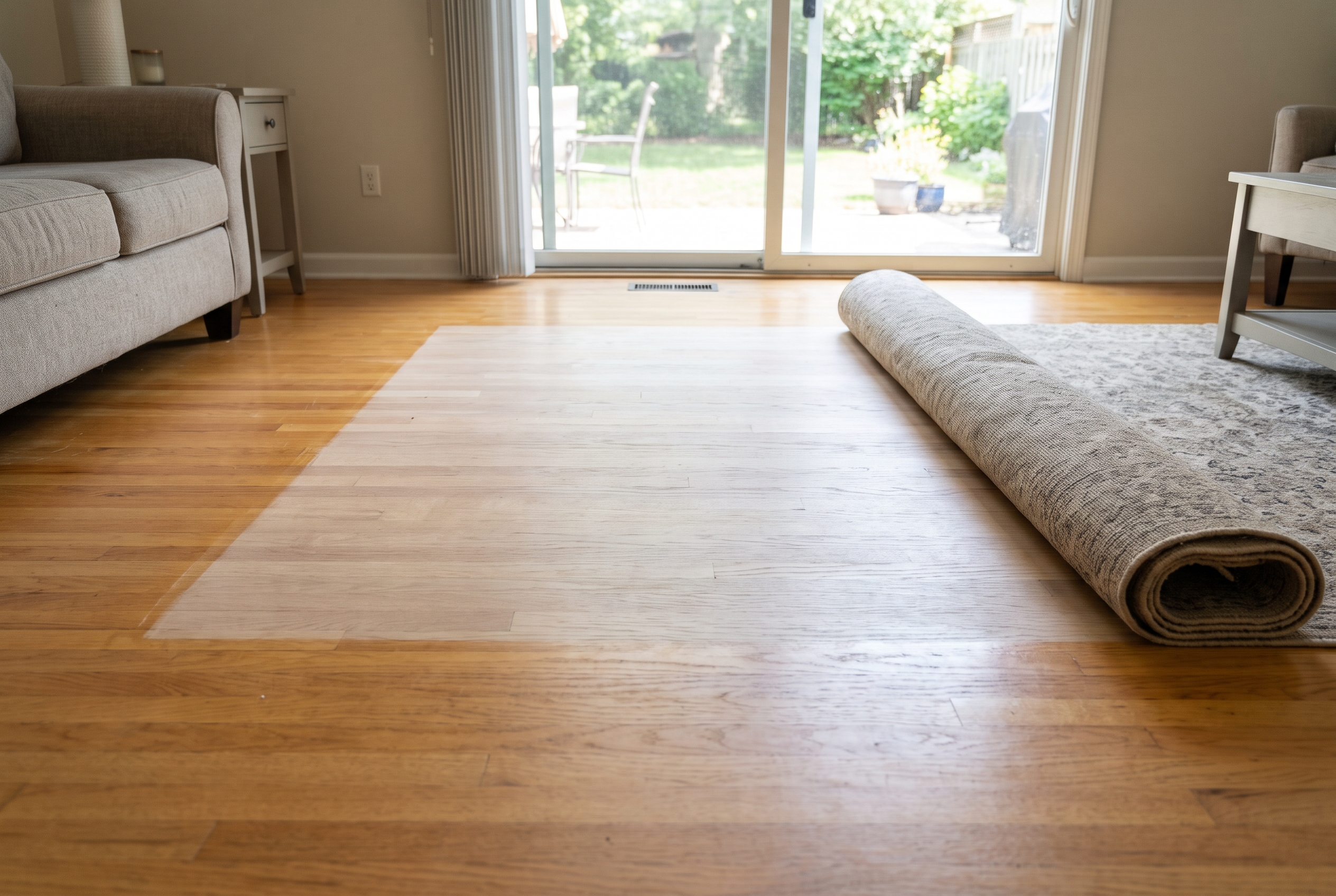
Sunlight changes the color of the wood itself, not the clear finish on top of it. That is why a sun-faded hardwood floor cannot be fixed with a recoat, a polish or a touch-up marker. The faded wood has to be sanded away and the floor refinished, and once that is done, the original color comes back.
Keeping the color even from then on is mostly about the windows. Film or low-E glass does the most work. Closing the blinds during direct afternoon sun comes next, and moving rugs and furniture around keeps the change even across the room. The finish you choose at the refinish comes last, and it helps less than most people expect.
One check comes before anything else. If the floor is engineered hardwood, the thickness of its real-wood top layer decides whether it can be sanded at all.
Here is how to read what you are seeing on the floor.
| What you see | What it usually means | What fixes it |
|---|---|---|
| A lighter or darker rectangle where a rug sat | The exposed floor changed color and the covered wood did not | Take the rug up and give it a bright season; if the line still shows, sand and refinish |
| The sunny room is paler or more amber than the hallway | Light has changed the surface of the wood | Sand and refinish the whole room |
| A floor that used to look pale has turned yellow, evenly, over the years | An oil-based finish has ambered with age | Sand off the old finish and refinish with a water-based finish |
| Dull and scuffed, but the same color everywhere | The finish is worn and the wood is fine | A screen and recoat |
Why Hardwood Floors Fade in Sunlight
Light breaks down the two things that give wood its color. One is lignin, the natural glue that holds the wood fibers together. The other is the extractives, the compounds that give each species its particular tone.
The USDA Forest Products Laboratory's Wood Handbook describes what happens. Lignin at the surface begins to break down within a few hours of exposure to ultraviolet light, and the extractives change color under either UV or visible light. All of it happens in a paper-thin layer at the surface, and the wood just beneath is unchanged.
The finish is not part of the reaction. A faded floor still feels smooth and sealed, because the clear coat on top is intact. That is also why sanding works: a single sanding removes more wood than the light has reached, and what it uncovers is the color the floor had on the day it was installed.
UV gets most of the blame, and it does start the process, but indoors it is only part of the story. Window glass filters out a share of the sun's UV before it reaches the floor, and the handbook's conclusion is that visible light causes most of the color change indoors. It adds that UV blockers in a finish do not necessarily stop that part of the change.
Heat speeds everything up. A floor that bakes in a hot patch of afternoon sun changes faster than the same floor in a cool room, and it dries out more as well.
Rooms with no direct sun still change, only slowly. A north-facing room shifts over years instead of months. A skylight is the exception people forget: it can put a moving patch of direct sun on a floor in a room with no windows at all.
None of this is a defect. Every real wood floor from every maker does it. The goal is to keep the change slow and even across the room, and to reverse it once it has become patchy.
How Quickly Sun Fading Shows Up
It depends on the species and the light. Cherry and the dark exotic woods can shift noticeably within weeks in direct sun. Oak beside a west-facing sliding door usually shows a difference after a single summer. A room that never gets direct sun takes years.
The change is fastest at the beginning and then slows down, so a new or freshly refinished floor moves more in its first summer than in the next several put together. That is why the first few months matter so much, and we come back to that below.
The simplest check is to lift the corner of a rug or a doormat after a few months of bright weather. If the wood under it is a different shade from the wood beside it, the room is changing, and the direction of the difference tells you which way.
The Lighter Patch Under the Rug: Will It Even Out?
Mostly, yes. The patch under the rug is the color the whole floor used to be, and the rest of the room has moved on without it. Once the rug comes up, the covered wood starts catching up, and over a bright season the difference usually fades to something you have to look for.
It rarely disappears completely. Wood that has had years of light and wood that has had none never quite meet in the middle, so a faint edge can remain. Whether that edge bothers you is what decides whether the room gets sanded.
The direction of the patch depends on the species. On oak, maple or cherry that has warmed or darkened, the covered patch is lighter. On a dark exotic floor beside a sliding door, where strong sun has bleached the exposed wood, the covered patch is darker, because it kept the color the sun took out of the rest.
What to do, in order:
- Take the rug up now and leave it off through a full bright season. The longer the rug stays put, the sharper the edge gets.
- Check the edge at the start and end of summer. If it has gone from a line you notice from the doorway to one you have to hunt for, it is doing what it should.
- Once the patch has caught up, put the rug back with a pad made for hardwood, and from then on rotate it and shift the furniture with the seasons.
- If the line is still obvious after a bright season with the rug up, the room needs a sanding, and the patch and the floor around it come back to one color together.
One mark that looks similar is not fading at all. A tacky or hazy outline where a rug sat, with no difference in color, is the rug's rubber or latex backing reacting with the finish. It is a finish problem: a recoat takes care of it, and a pad made for hardwood keeps it from coming back.
Which Wood Species Lighten, Darken or Amber in Sunlight
Every species changes, but not by the same amount or in the same direction, and that should shape what you choose for a sunny room.
Most of the common floors warm up. White oak and red oak turn more amber over the years. Maple yellows a little, hickory warms slightly while keeping its contrast, and ash goes from pale to a straw color. American walnut goes the other way and lightens toward golden brown.
Cherry and the dark exotic species move fastest. American cherry deepens to a rich red-brown within weeks in strong light. Brazilian cherry and most other tropical woods darken in ordinary room light, and under hard direct sun they can do the opposite and bleach paler.
| Species | How it changes in indoor light | How fast |
|---|---|---|
| White oak | Warms to amber; can go paler under strong direct sun | Moderate, over years |
| Red oak | Pink-tan deepens toward amber | Moderate, over years |
| Maple | Yellows slightly | Slow to moderate |
| Hickory | Warms a little; its light-and-dark contrast stays | Slow |
| Ash | Pale to a straw tan | Moderate |
| American walnut | Lightens toward golden brown | Moderate |
| American cherry | Deepens to a rich red-brown | Fast; weeks in direct sun |
| Brazilian cherry and other dark exotics | Darken in ordinary light; can bleach under direct sun | Fast |
That last point explains a floor that is lighter by the slider and darker everywhere else. In ordinary light, oak and many other species slowly deepen. Under strong direct sun every afternoon, the same wood can bleach instead. One floor can do both in two parts of the same house.
A stain changes the picture a little. Pigment blocks some of the light before it reaches the wood, so a stained floor shifts less than a natural one. But stain colorants can lighten under strong sun too, and on a dark floor any difference between covered and exposed wood stands out more. A dark stain beside a west-facing slider shows rug lines sooner than anything else.
For a room with a west or south slider, choose a mid-tone species with a moderate change, natural or lightly stained: white oak, red oak, hickory or maple. Save American cherry and the dark exotics for rooms with indirect light, where their darkening is even and looks like patina.
If you are deciding between species, start with our hardwood catalog, which can be filtered by species, and look at your shortlist in the room's own afternoon light before you commit.
Can You Fix a Sun-Faded Hardwood Floor Without Sanding?
No. Anything that goes on top of the old finish brings back shine, not color.
A screen and recoat lightly scuffs the existing finish and lays a fresh coat over it. It never touches the wood where the color changed, so a faded floor comes out of a recoat shinier and exactly as faded as before.
A recoat is still the right job in other situations. When the color is even across the room and the finish has simply gone dull, scuffed or lightly scratched, a recoat brings the floor back in about a day, and you can usually walk on it the next morning. The dividing line is color: if the room is two-tone, it needs sanding.
The products sold as quick fixes do less than they promise, and one of them makes the real fix harder.
- Floor polishes and restorers add gloss and no color. Most leave an acrylic film on the floor, and a new finish will not bond to it, so that film has to be found and stripped before anyone can recoat.
- Touch-up markers hide a scratch. They cannot blend a faded room, and a row of marker strokes on a pale floor looks like a row of marker strokes.
- Tinted restorers darken the whole surface a shade and wear off in the traffic paths first, so the room goes two-tone in a new way.
If a polish has ever been used on your floor, say so when you ask about a recoat. A drop of household ammonia in a hidden corner turns an acrylic film cloudy white, and that film has to come off before any new finish goes on.
A waxed floor is its own case. Wax has to be removed completely before urethane will stick, so a waxed floor that has faded goes straight to a sanding.
How a Sun-Faded Hardwood Floor Is Restored
The fix is a full sanding to fresh wood, a stain if you want one, two or three coats of finish, and some patience while the finish cures. A normal sanding removes less than 1/32 of an inch, and the sun-changed layer is thinner than that, so what comes up is the color the floor had when it was new.
Late fall is the natural time for it around here. The rugs come up, a summer's worth of lines shows, and the fresh surface gets the dim months to settle in before the strong sun returns.
Here is what the job involves.
- Identify the floor. Solid plank or engineered, and if engineered, how thick the real-wood top layer is. The carton label or the maker's spec sheet will tell you, and so will a spare board.
- Clear the room. Everything comes out, down to the rugs and the floor lamps.
- Sand the whole room. Several passes with progressively finer grit, until the faded surface is gone and the whole floor is one raw color. The sanding runs to a doorway or another natural break, never just to the edge of the faded patch.
- Choose the color from the raw wood. Fresh oak looks pale and pinkish compared with the floor you remember, and it starts changing again as soon as the finish cures. Pick the stain and finish for the color you want in two years, not the color on day one.
- Finish and cure. Two or three coats, then no foot traffic for a day or more, and no rugs or heavy furniture for about a week while the finish hardens all the way through.
- Give the floor its first months bare. Rugs go back once the fastest period of change has passed, and from then on they move with the seasons.
A solid 3/4-inch floor has enough wood for three to five sandings over its life, so for a solid floor, sun fading is a refinishing question and never a replacement question. An engineered floor needs two more questions answered first.
Should You Sand the Whole Room or Just the Faded Patch?
The whole room. A patch sanded and refinished in the middle of a floor never matches the aged wood around it. The untouched boards keep their years of color and their layers of old finish, and the join shows every time low sun rakes across it.
The only good place to stop a sanding is where the eye already expects a break: a doorway, a threshold strip, or a change in the direction of the boards. A dining room that has faded along its French doors can be done on its own if a doorway separates it from the hall. A great room that flows into the kitchen is one floor, and it gets done as one.
Can Engineered Hardwood Be Sanded After Sun Damage?
Yes, if the real-wood top layer is thick enough. The trade magazine of the National Wood Flooring Association, the NWFA, puts the line at 3/32 of an inch, about 2.5 millimeters: below that, a floor should not be sanded, and a screen and recoat is the only safe refresh.
Above the line, an engineered floor can usually be sanded once, and a thick top layer of four millimeters or more can take more than one sanding over its life. Many makers publish their own rules in millimeters, so the care guide that came with your floor is the first place to look.
If you have no paperwork, find a board edge you can see. A floor register, the gap under a transition strip at a doorway, or any gap wide enough to look down into will show the layers. The real wood is the layer above the tongue, and on most engineered boards you can make out the line where the veneer meets the core. It is not always easy to read, so if you are unsure, leave it as a question for the estimate visit rather than guessing.
If the top layer is too thin to sand, the color stays as it is and the plan changes to protection. A recoat refreshes the finish, film on the glass and rotated rugs keep the fade from getting more uneven, and a new floor waits until you are ready for one. A floor that has already been sanded through to its core is a replacement, and at that point the question becomes which construction suits a slab-built valley home.
How to Protect a Hardwood Floor From the Sun
Start at the glass, because it is the one step that works all day without anyone remembering to do anything. Then close the blinds on the glass that faces the afternoon sun, keep rugs and furniture moving, and choose the finish when the floor is refinished anyway.
None of these stops fading outright. The aim is slow and even, so the sunny room ages the way the hallway does and a rug never leaves a line.
| Protection | What it does | Trade-off |
|---|---|---|
| UV film on the glass that puts direct sun on the floor | Removes up to 99 percent of the UV; visible light and heat still come through a clear film | Check that your glass and its warranty allow film |
| Low-E or laminated replacement glass | Cuts fading damage by about three quarters compared with clear glass | New windows, the biggest job on this list |
| Blinds and shades closed during direct sun | Stops the light completely while they are closed | A darker room for part of the afternoon |
| Rugs and furniture rotated, and no rugs for the first months on a new floor | Keeps the change even; does not slow it | A few minutes twice a year |
| Water-based finish with UV inhibitors | Keeps the finish clear and slows the UV part of the change | Can only be chosen at a refinish |
Does UV Window Film Stop Hardwood Floors From Fading?
No, but it slows fading a great deal, and it is the smallest job you can do to a west-facing slider. According to the International Window Film Association, a window film can cut the sun's UV by up to 99 percent, and the same association says plainly that no film can eliminate fading. The visible light and heat that do much of the indoor work still come through a clear film.
Look for a film rated for UV rejection and for some heat and light rejection. Two numbers on the spec sheet tell you most of what you need. UV rejection should read 99 percent, and visible light transmission is the one to weigh: a lower number means less of the light that fades the floor and a slightly dimmer room. A film that trims the heat and a little of the glare does the most without making the room feel dark.
Film goes on the inside of the glass, on the slider and any window that puts direct sun on the floor. North-facing windows do not need it. If your windows already have a low-E coating, ask the film company whether those units can take film, because some coatings sit on the inside surface and some glass warranties limit what can be applied.
Do Low-E Windows Protect Hardwood Floors?
Yes, far better than clear glass, though no glass stops visible light. Clear glass stops the short-wave UV and lets most of the long-wave UV through. A low-E coating filters much more of it: the National Fenestration Rating Council's consumer guide puts the reduction in fading damage to floors, rugs and furniture at about 75 percent compared with clear glass. Laminated glass, with a UV-absorbing layer bonded between two panes, blocks both kinds of UV.
If you are shopping for new windows for the sunny side of the house, ask for the fade-resistance figure, called damage-weighted transmittance. It accounts for visible light as well as UV, a lower number is better, and it tells you more than a UV-only percentage.
The same consumer guide suggests an aftermarket low-E film for older windows that have no coating. For most of the houses we work in, that is the practical order: film on the original glass now, and low-E or laminated glass when the windows are replaced for their own reasons.
Which Blinds and Shades to Close, and When
Close the blinds or shades on whichever glass has direct sun on the floor, for the hours it is there, and leave the rest open. In summer that means the west and southwest glass from mid-afternoon until the sun drops behind the neighbors' roofs. In winter it means the south glass in the middle of the day, when the low sun reaches farther into a room than the high summer sun ever does.
Cellular shades and solar screens cut the heat along with the light, which matters on a 100-degree afternoon. Sheer curtains soften the glare but let most of the light through, so they do little for the floor.
Shade outside the window does the most of all, because it stops the sun before it reaches the glass. An awning over the slider, a solar screen on the outside of the window, or a tree on the west side of the house protects the floor and cools the room at the same time.
The trade-off is a darker room in the afternoon. With film on the glass, the blinds can stay open most days and come down on the hottest ones.
How to Place and Rotate Rugs So the Floor Ages Evenly
Keep rugs off a new or newly refinished floor for its first few months, which is what most makers' care guides ask for. The floor changes fastest in that period, and letting it happen with nothing on the floor is what keeps the color even. After that, rugs go down with pads and move with the seasons.
- Turn each rug end for end twice a year, and shift it a foot or two if the room allows, so the same boards are not covered year after year.
- Move the big pieces, the sofa, the sideboard and the piano, a few inches each season.
- Keep rugs out of the sunniest patch if you can. A rug in direct sun makes the sharpest line in the house, because the floor beside it is changing fastest.
- Use a pad made for hardwood under every rug and felt pads under the furniture legs, so all this moving does not scratch what it is meant to protect.
Moving things twice a year is enough for most rooms. The covered boards still fall a little behind, but never far enough to leave a line that will not catch up. The lines that end in a sanding come from a rug that sat in one place through several summers, or through one hard summer in direct sun.
Which Finish Slows Sun Fading?
The finish matters less than the glass, but it decides one thing: whether the floor keeps the color you saw on sanding day. The NWFA's guide to finishes describes oil-based finishes as amber and water-based finishes as normally clear. An oil-based finish is amber from the first coat and deepens for years, and on pale oak or maple that is the difference between the floor you chose and a yellower one.
Water-based finishes also dry faster between coats and carry far less solvent smell, so you can usually stay in the house while the floor is being finished.
A finish with UV inhibitors is worth having, as long as you know its limit. The inhibitors keep the finish itself from yellowing and slow the part of the change that UV causes. Visible light does most of the indoor work once the glass has removed the UV, and the Wood Handbook is clear that UV blockers in a finish do not necessarily stop that.
Pigment does more than any clear coat, because it blocks light before it reaches the wood. A lightly stained floor in a sunny room holds its color better than a natural one.
A floor with a hardwax oil finish shifts in the sun like any other wood floor, so it needs the same glass and the same rug routine; the difference is that it is refreshed by re-oiling rather than recoating. A factory aluminum-oxide finish is very tough on the surface and no shield at all for the color underneath.
Why Sun Fading Moves Faster in Roseville and the Sacramento Valley
A west-facing patio door in Roseville puts direct sun on the floor nearly every afternoon from May into October. That is the difference between a floor here and the same floor in a cloudier place.
NOAA's climate summary for Sacramento describes a nearly cloud-free sky through the whole summer and much of spring and fall, with the rainy season confined to November through March. The regional climate center's long-term records put Sacramento at about 97 percent of its possible sunshine in July and above 90 percent every month from May through September. The weather is good, so the blinds stay open, and the floor by the glass pays for it.
Heat adds its own damage. The same NOAA summary describes hot spells with afternoons above 100 degrees and humidity below 20 percent. On those afternoons the floor by the slider is the warmest surface in the house, and the wood there ages faster and dries out more than the wood in the hallway.
The gaps that open between boards in a dry summer come from that same afternoon heat. Shades down during the hottest hours help with both.
The houses around here make it matter. The Census Bureau's American Community Survey estimates for 2020 to 2024 put the median year built at 1998 in Roseville and Rocklin, 1997 in Folsom, 1987 in Granite Bay, 1977 in Citrus Heights and 1976 in Orangevale. Many of those are the family homes with the big slider off the family room and the tall foyer window, and many of them still have their original glass.
Original windows from those years often have no low-E coating, which makes them exactly the windows an aftermarket film is meant for. The hardwood in those houses is old enough to have faded, and if it is solid, it has plenty of wood left to sand.
For a floor here, that means film on the west and south glass before anything else, and no dark exotic species in the west-facing room.
What We Do About a Faded Floor at Granite Bay Flooring and Design
Granite Bay Flooring and Design is a family-owned store in Roseville, and hardwood refinishing is done by our own in-house crews. We also do flooring repairs.
It starts with a free in-home measurement and estimate, anywhere from Lincoln and Loomis down to Folsom and El Dorado Hills, and across Granite Bay, Roseville, Rocklin, Citrus Heights, Antelope and Orangevale. We look at the floor in the light it actually gets, work out whether it is solid or engineered, and tell you plainly whether it needs a sanding or a recoat. If the floor is a thin engineered plank, we say so, and the conversation turns to protecting the color you have.
Have the carton label or a spare board ready if you have one. The top-layer thickness is printed on the label, and a spare board shows it at a glance.
Furniture removal is one of the services on our list, and so are custom area rugs and rug binding, which means a rug can be made to fit the room instead of the other way around. Ask about either when you book.
If the answer turns out to be a new floor, we carry solid and engineered hardwood in a wide range of species. For a room with a west-facing slider we steer toward a mid-tone oak, hickory or maple, and we talk about the glass in the same visit.
Questions We Hear About Sun-Faded Hardwood Floors
Does Engineered Hardwood Fade Faster Than Solid?
No. The top of an engineered plank is the same real wood as a solid plank, and light changes it the same way. The difference is underneath: a solid floor has wood for several sandings over its life, and an engineered floor has one or a few, depending on the thickness of its top layer.
Will a Refinished Floor Fade Again?
Yes, and fastest in its first months, because the fresh surface starts changing as soon as the finish cures. That is why the glass and the rug-free first months matter from day one.
A refinished floor behind film, with rugs that move, changes slowly and evenly, which is what you paid for. A refinished floor behind bare west glass, with a rug back on it in week two, is on its way to the same rectangle.
Do Laminate and Vinyl Plank Fade in the Sun?
Both have a printed design layer sealed under a hard wear layer, which resists fading far better than bare wood, but neither is immune. Makers' care guides for laminate and luxury vinyl ask for blinds or drapes during peak sun, and some allow a UV film on the glass, because years of strong direct sun can still discolor the surface and the heat can make a vinyl plank expand.
Neither floor can be sanded, so for these floors the glass and the blinds do all of the protecting.
Is Sun Fading Covered by a Hardwood Floor Warranty?
Usually not. Makers treat color change from light as the nature of wood rather than a defect, and most care guides say so in as many words. What the warranty covers is the finish and the construction.
Keep the care guide and the warranty booklet with your spare boards. They spell out what the maker counts as normal color change, and they are the first thing anyone will ask for if a question ever comes up.
How Long Does Refinishing a Sun-Faded Room Take?
The sanding and the coats take a few days for a typical room, and the finish keeps hardening for days after the last coat goes on. Water-based finishes dry faster between coats than oil-based ones, which shortens the job.
The week or so before the rugs and heavy furniture go back is the finish curing all the way through. It is the step people are most tempted to skip, and the one that decides how the new finish holds up.
Get the Faded Room Looked At Before Next Summer
Rug lines get sharper with every summer the glass goes untreated, and a refinish done in the fall gives the new surface the dim months to settle before the strong sun returns. If the room by the slider has gone pale, or a rug came up to a rectangle, book a free in-home estimate. We will look at the floor and the windows it faces, tell you whether it needs a sanding or a recoat, and measure the rooms while we are there.


